

 Open Access||Research Article
An AI-Driven Integrated Framework for Automated Web Application Penetration Testing Using Multi-Tool Vulnerability Assessment
Vijaykumar Bidve1 , Kiran Kakade2, Vinod Kimbahune1, Kapil Vhatkar1
1 Department of Computer Engineering, Vishwakarma Institute of Technology (VIT), Pune, Maharashtra, 411037, India
2 Faculty of Management, Symbiosis Institute of Management Studies, Symbiosis International (Deemed University), Pune, Maharashtra, 411020, India
Abstract
The rapid growth of web-based applications and cloud computing has significantly increased organizations' exposure to sophisticated cyber threats. Conventional penetration testing methods often require extensive manual effort, specialized expertise, and considerable time to identify security vulnerabilities, making them less suitable for continuously evolving digital infrastructures. Recent advancements in artificial intelligence (AI) and intelligent automation provide an opportunity to enhance vulnerability assessment by improving detection accuracy, reducing human intervention, and accelerating security analysis. This paper presents an AI-driven integrated framework for automated web application penetration testing that combines multiple industry-recognized security tools, including OWASP ZAP, Burp Suite Professional, FOCA, and Vega, within a unified graphical interface developed using Python. The proposed framework automates reconnaissance, vulnerability scanning, analysis, report generation, and remediation recommendation while maintaining flexibility for security professionals to customize scanning parameters. Multithreading and multiprocessing techniques are employed to improve scanning efficiency and enable the simultaneous execution of multiple security assessments. The framework also incorporates intelligent vulnerability prioritization based on severity levels and integrates structured reporting mechanisms to support organizational compliance and risk management activities. A comprehensive literature review and gap analysis identify the limitations of existing automated penetration testing solutions and motivate the development of the proposed architecture. Experimental analysis demonstrates the effectiveness of integrating multiple vulnerability scanners to improve the detection of common web application vulnerabilities such as SQL injection, cross-site scripting, broken authentication, cross-site request forgery, XML external entity attacks, insecure configurations, and API-related security flaws. Comparative analysis reveals that the integrated framework provides broader vulnerability coverage, improved usability, enhanced reporting capabilities, and greater operational efficiency than standalone scanning tools do. The proposed framework contributes to intelligent cybersecurity automation by providing a scalable, extensible, and user-friendly solution capable of supporting modern web application security assessments while reducing the complexity and cost associated with traditional penetration testing methods.
Keywords
Graphical Abstract
1. Introduction
The rapid advancement of digital technologies has transformed the way organizations conduct business, communicate, and deliver services. The widespread adoption of web applications, cloud computing, mobile platforms, and Internet of Things (IoT) technologies has significantly enhanced operational efficiency and accessibility. However, this digital transformation has simultaneously expanded the attack surface, exposing organizations to an increasing number of sophisticated cyber threats. As cyberattacks become more frequent and complex, ensuring the confidentiality, integrity, and availability of digital assets has become a major challenge for governments, industries, financial institutions, healthcare organizations, and educational institutions. Consequently, cybersecurity has emerged as a critical discipline for protecting information systems against evolving cyber threats. Early studies on penetration testing highlighted the importance of systematically identifying vulnerabilities before they can be exploited by attackers, thereby establishing penetration testing as an essential component of modern cybersecurity practices. [1]
Cybersecurity refers to the collection of technologies, policies, standards, processes, and best practices that protect computer systems, communication networks, software applications, and digital information from unauthorized access, cyberattacks, and data breaches. An effective cybersecurity strategy extends beyond traditional security mechanisms such as firewalls and antivirus software by incorporating continuous monitoring, vulnerability assessment, penetration testing, incident response, and risk management. Among these security practices, penetration testing has gained significant importance because it simulates real-world cyberattacks to identify exploitable vulnerabilities before malicious actors can compromise organizational resources. A comprehensive survey on web penetration testing demonstrates that proactive vulnerability assessment significantly improves the security posture of web-based applications by identifying weaknesses during the software lifecycle. [2]
Web applications remain among the primary targets of cybercriminals because of their widespread deployment and direct accessibility over the internet. The Open Worldwide Application Security Project (OWASP) has consistently identified vulnerabilities such as SQL Injection, Cross-Site Scripting (XSS), Broken Authentication, Security Misconfiguration, Cross-Site Request Forgery (CSRF), and XML External Entity (XXE) attacks among the most critical security risks affecting modern web applications. Addressing these vulnerabilities requires continuous vulnerability assessment and regular penetration testing to reduce the likelihood of successful cyberattacks. OWASP-driven security surveys emphasize that proactive vulnerability identification and secure coding practices significantly improve application security and organizational resilience against emerging threats. [3]
Traditional penetration testing is performed primarily manually by cybersecurity professionals who conduct reconnaissance, vulnerability discovery, exploitation, privilege escalation, and security reporting using specialized penetration testing tools. Although manual penetration testing provides detailed and reliable security assessments, it requires highly skilled professionals, considerable execution time, and substantial financial investment. Furthermore, modern software development practices such as agile, DevSecOps, and continuous integration/continuous deployment (CI/CD) require frequent security validation, which is difficult to achieve through manual testing alone. Automated penetration testing frameworks have therefore been proposed to improve efficiency while maintaining comprehensive vulnerability coverage. [4]
The effectiveness of penetration testing also depends on understanding the techniques adopted by adversaries during reconnaissance and attack preparation. Modern attackers employ sophisticated reconnaissance methods to gather information regarding network infrastructure, operating systems, web technologies, exposed services, and application configurations before launching targeted attacks. A comprehensive taxonomy of adversarial reconnaissance techniques demonstrates the growing complexity of modern cyber attacks and highlights the necessity for intelligent automation in vulnerability assessment and penetration testing. [5] Similarly, comparative studies of black-box web vulnerability scanners reveal that individual scanning tools often fail to detect all categories of vulnerabilities, indicating the need to integrate multiple security assessment techniques within a unified framework. [6]
Recent advances in artificial intelligence (AI) have significantly influenced the field of cybersecurity by enabling intelligent automation, adaptive learning, and predictive threat analysis. AI enables computer systems to analyze large volumes of security data, identify hidden attack patterns, classify vulnerabilities, detect anomalies, and continuously improve detection accuracy through machine learning algorithms. Compared with traditional rule-based approaches, machine learning-based vulnerability detection methods have demonstrated promising results in terms of improving the efficiency and accuracy of automated security assessments. [7] Furthermore, vulnerability mapping techniques based on the OWASP Top Ten facilitate systematic identification and classification of software vulnerabilities, enabling organizations to prioritize remediation activities according to associated security risks. [8]
The increasing complexity of cyber threats has motivated researchers to investigate intelligent approaches for vulnerability detection and prevention. Recent surveys on web application security emphasize that integrating automated vulnerability assessment with intelligent security analysis significantly enhances organizational cyber resilience while reducing manual effort and operational costs. [9] Additional studies focusing on OWASP-based protection mechanisms further demonstrate the importance of combining multiple defensive strategies to provide comprehensive security coverage against evolving cyber threats. [10]
Numerous commercial and open-source penetration testing tools have been developed to automate vulnerability assessment. Comparative evaluations of vulnerability scanners indicate that each tool has unique strengths in detecting specific categories of vulnerabilities but has limitations. [11] Consequently, relying solely on a single vulnerability scanner may result in incomplete security assessments. Additional OWASP-driven studies also recommend the integration of complementary security tools to improve detection accuracy and vulnerability coverage. [12] Earlier analyses of black-box vulnerability scanners similarly concluded that no individual scanner provides complete protection against all classes of web application vulnerabilities. [13]
The growing demand for intelligent security automation has encouraged the development of penetration testing solutions across emerging technologies such as the Internet of Things (IoT), cloud computing, and distributed systems. Automated penetration testing has demonstrated significant potential for improving the scalability and consistency of vulnerability assessments while reducing human intervention. [14] Comprehensive reviews of automated penetration testing further indicate that integrating multiple security assessment tools into a centralized platform can substantially improve operational efficiency, vulnerability management, and reporting capabilities. [15] Likewise, usability studies on OpenVAS vulnerability scanners emphasize the importance of user-friendly interfaces and efficient vulnerability reporting for effective security management. [16]
In addition to vulnerability scanners, exploitation frameworks such as Metasploit have become indispensable components of penetration testing because they support exploit validation and postexploitation analysis. [17] Automated planning techniques for remote penetration testing have further demonstrated the feasibility of coordinating multiple security tools within a unified testing framework, thereby reducing the complexity associated with manual penetration testing activities. [18] Commercial solutions such as Burp Suite Professional provide advanced web vulnerability scanning, proxy-based traffic interception, and comprehensive security testing capabilities for web applications, whereas network vulnerability assessment tools such as Nessus provide extensive support for infrastructure security analysis and configuration assessment. [19,20] Recent comparative studies involving commercial and open-source vulnerability scanners continue to emphasize that compared with standalone tools, the integration of multiple scanners significantly improves vulnerability detection capability. [21,22] More recently, researchers have proposed multi-scanner automated penetration testing frameworks that combine different vulnerability assessment engines to improve security coverage and reduce false negatives. [23] Furthermore, advances in artificial intelligence, particularly deep reinforcement learning, have demonstrated the potential for intelligent attack automation, adaptive penetration testing, and autonomous vulnerability discovery, representing important directions for next-generation cybersecurity systems. [24]
Motivated by these research findings, this paper proposes an AI-driven integrated framework for automated web application penetration testing that combines the capabilities of OWASP ZAP, Burp Suite Professional, Vega, and FOCA within a unified Python-based graphical user interface. The proposed framework automates reconnaissance, vulnerability scanning, result aggregation, severity classification, report generation, and remediation support while employing multithreading and multiprocessing techniques to improve execution efficiency. By integrating multiple penetration testing tools into a centralized platform, the proposed system enhances vulnerability coverage, reduces manual effort, improves usability, and supports comprehensive security assessments for modern web applications. The major contributions of this research are summarized as follows:
- Development of an AI-assisted integrated penetration testing framework combining OWASP ZAP, Burp Suite Professional, Vega, and FOCA.
- Design of a scalable Python-based architecture supporting automated vulnerability scanning, intelligent report generation, and centralized vulnerability management.
- Multiple penetration testing tools are compared to analyze their effectiveness in detecting diverse categories of web application vulnerabilities.
- Integration of multithreading and multiprocessing techniques can improve scanning efficiency and reduce execution time.
- Provision of an extensible cybersecurity framework capable of incorporating future artificial intelligence, machine learning, and automated threat intelligence techniques.
2. Literature Review
The increasing frequency and sophistication of cyberattacks have motivated researchers to develop efficient techniques for identifying and mitigating software vulnerabilities. Web applications have become the primary targets of attackers because of their widespread deployment, extensive user interaction, and direct exposure to public networks. Consequently, automated penetration testing has emerged as a critical research area aimed at improving the efficiency, accuracy, and scalability of vulnerability assessment. Numerous commercial and open-source tools have been developed to automate different phases of penetration testing, including reconnaissance, vulnerability scanning, exploitation, reporting, and remediation. However, the effectiveness of these tools varies considerably depending on the vulnerability type, testing methodology, and application architecture.
McDermott et al. introduced one of the earliest systematic approaches to penetration testing by modeling attack networks for evaluating system security. [1] Their work demonstrated the importance of proactive vulnerability assessment and established penetration testing as an essential component of cybersecurity. Later, Mirjalili et al. presented a comprehensive survey of web penetration testing techniques, highlighting the advantages and limitations of automated vulnerability scanners while emphasizing the need for continuous security assessment throughout the software development lifecycle. [2] By identifying the most critical vulnerabilities affecting modern applications, the Open Worldwide Application Security Project (OWASP) has significantly influenced web application security. Fredj et al. analyzed various protection mechanisms based on the OWASP Top Ten vulnerabilities and discussed effective strategies for preventing common web application attacks. [3] Similarly, Samant proposed an automated penetration testing framework that demonstrated the benefits of reducing manual effort while improving testing consistency. [4] Roy et al. further investigated adversarial reconnaissance techniques and classified various attack strategies employed by cybercriminals before launching sophisticated cyberattacks. [5]
Several researchers have evaluated the performance of existing vulnerability scanners. Doupé et al. conducted an extensive analysis of black-box web vulnerability scanners and concluded that individual scanners often fail to detect several important classes of vulnerabilities. [6] Their findings motivated the development of integrated security assessment platforms capable of combining multiple scanning engines. Machine learning techniques have also been increasingly applied to cybersecurity. Hu et al. proposed a machine learning-based vulnerability detection approach that demonstrated improved accuracy in identifying web application vulnerabilities. [7] Likewise, Li introduced vulnerability mapping techniques based on the OWASP-SANS framework to support systematic software security assessment. [8] Surveys conducted by Noman et al. and Fredj et al. highlighted the importance of integrating multiple defensive mechanisms for effective vulnerability detection and prevention. [9,10] Comparative evaluations performed by Amankwah et al. demonstrated that commercial and open-source vulnerability scanners exhibit complementary strengths and weaknesses, suggesting that integrated security frameworks can achieve better vulnerability coverage than standalone tools can achieve. [11] Similar observations were reported in subsequent OWASP-driven studies and comparative analyses of black-box scanners. [12,13]
The emergence of intelligent cybersecurity has encouraged researchers to develop automated penetration testing systems capable of integrating multiple security tools. Chu and Lisitsa investigated automated penetration testing in Internet of Things (IoT) environments, whereas Dabaseh and Alshammari presented a comprehensive overview of automated penetration testing technologies and their practical applications. [14,15] Aksu et al. evaluated the usability of OpenVAS vulnerability scanners and emphasized the importance of efficient reporting mechanisms. [16] Raj and Walia demonstrated the usefulness of the Metasploit framework for exploit validation and post-exploitation analysis, whereas Greenwald and Shanley proposed automated planning techniques for remote penetration testing. [17,18] Commercial security assessment tools such as Burp Suite Professional and Nessus continue to play important roles in industrial penetration testing because of their advanced vulnerability detection capabilities and comprehensive reporting features. [19,20] Comparative studies by Amankwah et al. and Pandit confirmed that no individual vulnerability scanner provides complete vulnerability coverage across all categories of cyber threats. [21,22] More recently, Abdulghaffar et al. proposed integrating multiple vulnerability scanners to improve the overall effectiveness of automated penetration testing. [23] Furthermore, Jabr et al. demonstrated the application of artificial intelligence and deep reinforcement learning for automated attack simulation, highlighting the growing role of AI in next-generation penetration testing systems. [24]
Table 1: Classification of web application vulnerabilities
| Category | Representative Vulnerabilities | Examples |
|---|---|---|
| Injection Vulnerabilities | SQL Injection, Command Injection, LDAP Injection, XPath Injection, SSTI | Unauthorized database access, Remote Code Execution |
| Cross-Site Attacks | Reflected XSS, Stored XSS, DOM-based XSS, CSRF | Client-side code execution, Session hijacking |
| Authentication & Session Management | Broken Authentication, Session Fixation, Weak Passwords, Cookie Poisoning | Account takeover, Privilege escalation |
| Authorization & Access Control | Broken Access Control, IDOR, Path Traversal, Directory Browsing | Unauthorized resource access |
| Security Misconfiguration | Default Credentials, Misconfigured CORS, Exposed Git/SVN, Debug Mode | Information disclosure |
| Cryptographic Vulnerabilities | Weak Encryption, Certificate Tampering, SSL/TLS Misconfiguration | Confidentiality compromise |
| API & Web Services Security | REST API Misconfiguration, SOAP Action Spoofing, GraphQL Weaknesses | Unauthorized API access |
| Server-Side Vulnerabilities | Remote File Inclusion, Local File Inclusion, XXE, Server-Side Template Injection | Remote Code Execution |
| Client-Side Vulnerabilities | JavaScript Injection, Clickjacking, Reverse Tabnabbing | Browser compromise |
| Information Disclosure | Source Code Disclosure, Error Message Leakage, Metadata Exposure | Leakage of sensitive information |
| Availability Attacks | Application DoS, Slow HTTP Attack, Resource Exhaustion | Service disruption |
| Emerging Threats | Cryptojacking, Cache Deception, WebDriver Exploitation | Advanced persistent attacks |
Although significant progress has been made in automated vulnerability assessment, existing approaches continue to exhibit several limitations. Most available tools specialize in specific categories of vulnerabilities and operate independently, requiring security professionals to manually execute multiple scanners and consolidate the generated reports. Moreover, limited integration among heterogeneous security tools, inadequate vulnerability prioritization, and insufficient automation of reporting remain major challenges. These limitations provide strong motivation for developing an integrated AI-driven penetration testing framework capable of combining the strengths of multiple vulnerability scanners within a unified architecture. To simplify the analysis of web application vulnerabilities identified in previous studies, the numerous vulnerability types reported in the literature have been clustered into broader security categories. This categorization facilitates systematic vulnerability assessment and supports the efficient selection of appropriate penetration testing techniques. Table 1 presents the classification of web application vulnerabilities. The original vulnerability dataset included 78 individual vulnerabilities identified from OWASP, Burp Suite Professional, and related literature. For improved readability and comparative analysis, these vulnerabilities have been consolidated into 12 logical categories on the basis of their attack objectives and security impact. This clustering enables efficient vulnerability management while reducing redundancy during security assessment.
2.1 Research Gap Analysis
The growing adoption of automated penetration testing has encouraged researchers to develop various frameworks for vulnerability assessment using commercial and open-source security tools. Although significant progress has been made in automating vulnerability detection, existing solutions continue to exhibit several technical and operational limitations. Most currently available penetration testing frameworks focus on individual security tools, resulting in fragmented vulnerability assessment, limited automation, incomplete security coverage, and increased manual effort during report consolidation. Furthermore, the rapid emergence of artificial intelligence (AI) presents new opportunities for improving penetration testing through intelligent vulnerability prioritization, adaptive learning, and automated decision support, which remain insufficiently explored in existing research.
Several studies have investigated automated penetration testing methodologies using individual vulnerability scanners. [1] McDermott introduced attack-net modeling for systematic penetration testing, whereas Mirjalili et al. surveyed web penetration testing approaches and highlighted the limitations of conventional vulnerability assessment techniques. [2] Fredj et al. proposed OWASP-driven protection mechanisms for mitigating common web application vulnerabilities, whereas Samant demonstrated the advantages of automating penetration testing workflows. [3,4] However, these studies focused primarily on improving the individual stages of penetration testing rather than providing an integrated vulnerability assessment framework.
Recent advances in machine learning and AI have enabled intelligent cybersecurity applications for anomaly detection, malware classification, vulnerability prediction, and automated threat analysis. [7,9] Nevertheless, relatively few studies have incorporated AI into practical penetration testing frameworks capable of integrating multiple vulnerability assessment tools. Existing commercial scanners such as Burp Suite Professional, OWASP ZAP, Nessus, Vega, and OpenVAS perform specialized security assessments independently and generate separate vulnerability reports. [11,16,19,20] Consequently, cybersecurity professionals must manually execute multiple scans, correlate duplicate findings, prioritize vulnerabilities, and prepare consolidated reports, increasing both execution time and operational complexity.
Comparative evaluations of vulnerability scanners indicate that no individual tool provides comprehensive detection of all categories of web application vulnerabilities. [6,11,21,22] OWASP ZAP demonstrates strong capabilities for automated web application scanning, whereas Burp Suite Professional offers advanced manual testing and interception mechanisms. FOCA specializes in metadata extraction during reconnaissance, whereas Vega provides lightweight vulnerability scanning suitable for small and medium-sized web applications. The complementary strengths of these tools suggest that integrating multiple vulnerability scanners into a unified platform can significantly improve vulnerability coverage while reducing redundant scanning activities.
Recent research has also highlighted the importance of AI-assisted penetration testing. Abdulghaffar et al. proposed integrating multiple vulnerability scanners to improve automated web application security assessment. [23] Similarly, Jabr et al. demonstrated the potential of deep reinforcement learning for intelligent attack automation and adaptive penetration testing. [24] Although these studies illustrate the benefits of intelligent automation, they provide limited discussion regarding unified graphical interfaces, centralized vulnerability management, concurrent scanning mechanisms, and intelligent report generation suitable for practical industrial deployment.
On the basis of the literature review, several research gaps remain unaddressed:
- Unified integration of multiple penetration testing tools within a single security assessment framework is lacking.
- Limited application of artificial intelligence for intelligent vulnerability prioritization and automated security decision support.
- Centralized vulnerability management capable of consolidating duplicate findings generated by heterogeneous scanners is lacking.
- Insufficient automation of report generation and vulnerability severity classification.
- Limited scalability for performing concurrent vulnerability assessments using multithreading and multiprocessing techniques.
- Inadequate support for extensibility, making the integration of emerging cybersecurity tools difficult.
To overcome these limitations, this research proposes an AI-driven integrated automated penetration testing framework that combines OWASP ZAP, Burp Suite Professional, Vega, and FOCA within a unified Python-based graphical interface. The proposed framework automates reconnaissance, vulnerability scanning, result aggregation, severity classification, and report generation while utilizing concurrent execution techniques to improve scanning efficiency. Furthermore, the modular architecture enables future integration of AI-based vulnerability prediction, intelligent remediation recommendation, and adaptive threat analysis, making the framework suitable for modern cybersecurity environments.
Table 2 summarizes the major contributions and limitations of representative studies in automated penetration testing. Although previous research has advanced vulnerability detection through the automation, machine learning, and comparative evaluation of security scanners, significant challenges remain in achieving comprehensive vulnerability coverage and intelligent security management. The proposed framework addresses these limitations by integrating multiple penetration testing tools into a centralized platform, automating vulnerability assessment workflows, improving reporting mechanisms, and providing a scalable architecture capable of supporting future AI-based cybersecurity enhancements.
Table 2: Comparative analysis and research gap identification
| Sr. No. | Research Work | Methodology | Limitations | Research Gap Addressed in Proposed Work |
|---|---|---|---|---|
| 1 | Attack Net Penetration Testing | Attack graph modeling | Limited automation | AI-enabled integrated framework |
| 2 | Survey on Web Penetration Testing | Review of testing tools | No unified implementation | Multi-tool integration |
| 3 | OWASP Top-10 Protection Methods | OWASP-based vulnerability analysis | Limited tool integration | Integrated OWASP-based scanning |
| 4 | Automated Penetration Testing | Automation framework | Limited scalability | Concurrent multitool execution |
| 5 | Adversarial Reconnaissance | Attack taxonomy | Focus only on reconnaissance | End-to-end penetration testing |
| 6 | Black-box Vulnerability Scanner Analysis | Comparative evaluation | No scanner detects all vulnerabilities | Multi-scanner integration |
| 7 | ML-based Vulnerability Detection | Machine learning | Single-model implementation | AI-assisted vulnerability prioritization |
| 8 | OWASP-SANS Vulnerability Mapping | Static security mapping | Limited automation | Automated vulnerability classification |
| 9 | Web Vulnerability Survey | Detection & prevention survey | Conceptual discussion | Practical integrated framework |
| 10 | OWASP Protection Survey | Security mechanisms | No implementation | Practical deployment |
| 11 | Commercial vs Open-source Scanners | Comparative analysis | Independent tool evaluation | Unified scanning platform |
| 12 | Automated Penetration Testing Overview | Literature review | No implementation | Practical AI-enabled framework |
| 13 | Burp Suite Professional | Commercial scanner | Tool-specific | Integrated operation |
| 14 | Multi-Scanner Automated Testing | Multiple scanners | Limited GUI integration | Centralized GUI and reporting |
| 15 | AI-based Attack Automation | Deep Reinforcement Learning | Simulation focused | Practical AI-assisted penetration testing framework |
3. Proposed Methodologies
3.1 Proposed AI-Driven Automated Penetration Testing Framework
Modern web applications continuously face sophisticated cyber threats that exploit security vulnerabilities across different layers of application architecture. Conventional penetration testing relies heavily on manual intervention, multiple standalone security tools, and expert analysis, making the process time-consuming and resource intensive. Furthermore, individual penetration testing tools possess specialized capabilities but often fail to provide complete vulnerability coverage. To overcome these limitations, this research proposes an AI-driven Integrated Automated Penetration Testing Framework that combines multiple vulnerability assessment tools into a unified platform capable of performing intelligent vulnerability detection, centralized report generation, and automated security analysis.
The proposed framework integrates four widely adopted penetration testing tools—OWASP ZAP, Burp Suite Professional, FOCA, and Vega—in a Python-based graphical user interface (GUI). The framework automates the complete penetration testing lifecycle, including target initialization, reconnaissance, vulnerability scanning, vulnerability aggregation, severity classification, report generation, and remediation recommendation. Multithreading and multiprocessing techniques enable concurrent execution of multiple scanners, thereby reducing the total assessment time while improving overall vulnerability coverage.
Unlike conventional approaches that require security professionals to execute each scanner independently and manually consolidate reports, the proposed framework automatically integrates outputs from different tools, removes duplicate findings, categorizes vulnerabilities according to their severity, and generates comprehensive security reports. Artificial intelligence assists in vulnerability prioritization by analyzing scanner outputs, identifying duplicate vulnerabilities, estimating risk levels, and recommending appropriate remediation strategies on the basis of historical vulnerability patterns and predefined security knowledge. The proposed architecture is designed as a modular and scalable framework, allowing additional security tools, AI models, and reporting modules to be integrated with minimal architectural modifications.
3.2 Proposed System Architecture
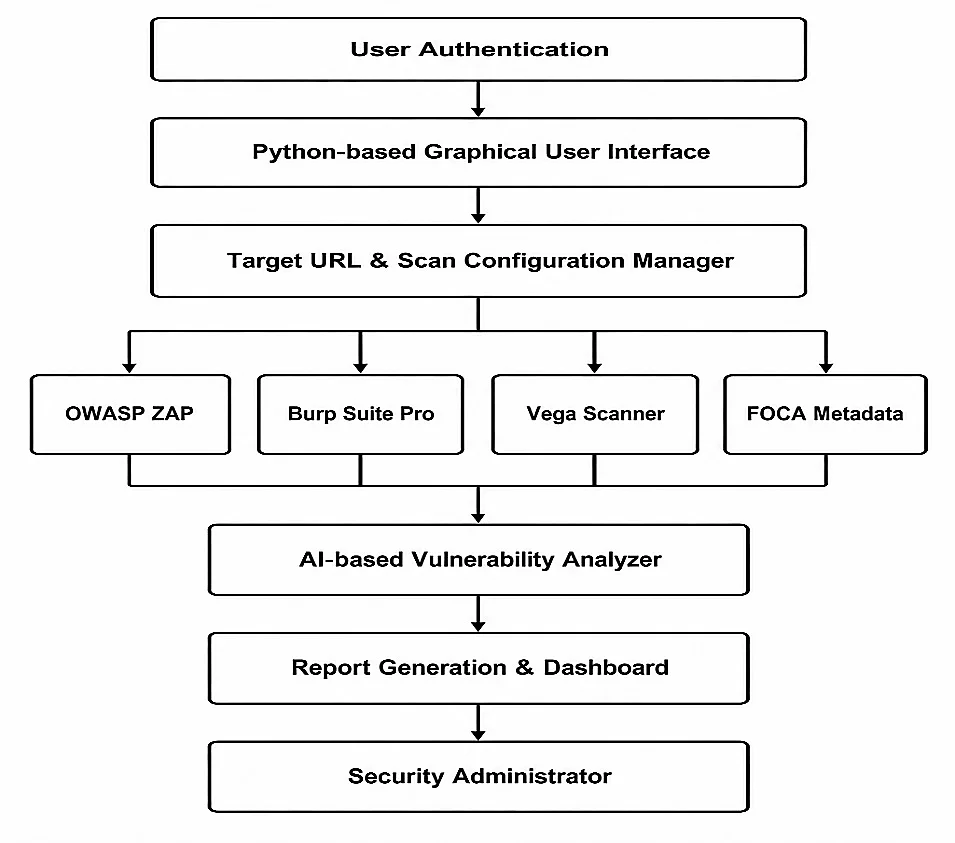
The overall architecture of the proposed framework consists of seven functional layers, as illustrated in Fig. 1.
Fig. 1: Proposed AI-driven integrated penetration testing architecture.
The proposed architecture consists of the following functional components:
- User Authentication Module: This module authenticates authorized users before allowing penetration testing activities. Authentication mechanisms prevent unauthorized execution of security scans and maintain audit logs for compliance purposes.
- Graphical User Interface (GUI): A Python-based GUI serves as the centralized interface through which security analysts configure scanning parameters, select penetration testing tools, monitor scan progress, and visualize vulnerability reports. The GUI eliminates the need to execute individual command-line tools separately.
- Target Configuration Module: This module accepts target information, including the target URL, IP address, port numbers, authentication credits, scan policies, scan depth, and crawl configuration. The module validates all the inputs before initiating the vulnerability assessment.
- Multi-Tool Scanning Engine: The scanning engine coordinates multiple penetration testing tools simultaneously. The integrated scanners include OWASP ZAP (web application vulnerability scanning, passive and active scanning, API security assessment), Burp Suite Professional (proxy interception, advanced vulnerability detection, manual verification), Vega (lightweight web vulnerability scanning, automated crawling, injection detection), and FOCA (metadata extraction, information gathering, DNS enumeration, document analysis). Each scanner contributes complementary vulnerability information, thereby increasing overall detection coverage.
- AI-based Vulnerability Analysis Engine: This module represents the primary novelty of the proposed framework. The AI engine performs vulnerability correlation, duplicate vulnerability removal, severity prediction, risk prioritization, recommendation generation, and attack pattern identification. The engine analyses vulnerability reports generated by different scanners and produces a consolidated list ranked according to organizational risk. Future versions may incorporate supervised machine learning algorithms such as random forest, XGBoost, or deep neural networks for adaptive vulnerability prediction.
- Report Generation Module: The reporting engine generates comprehensive penetration testing reports in multiple formats, including PDF, HTML, CSV, and JSON. Each report contains the Executive Summary, Vulnerability Details, CVSS Severity Score, Affected Components, Recommended Fixes, Toolwise Findings, and Overall Risk Rating.
- Dashboard Module: The dashboard presents summarized security information through graphical visualization, including total vulnerabilities and high-, medium-, and low-risk distributions, Vulnerability Trends, Tool-wise Detection Statistics, Scan Duration, and Security Score.
3.3 Advantages of the Proposed Framework
Compared with conventional penetration testing approaches, the proposed framework offers several advantages:
- Unified integration of multiple penetration testing tools through a single graphical interface.
- AI-assisted vulnerability prioritization for improved decision-making.
- Concurrent execution using multithreading and multiprocessing reduces the assessment time.
- Centralized vulnerability management with duplicate elimination and consolidated reporting.
- Support for multiple report formats (PDF, HTML, CSV, JSON).
- Modular architecture enabling future integration of AI models, machine learning techniques, and additional security tools.
- Improved vulnerability coverage by combining the complementary strengths of OWASP ZAP, Burp Suite Professional, Vega, and FOCA.
- Scalable and extensible design suitable for enterprise web application security assessments.
4. Results and Discussion
4.1 Experimental Setup
The proposed AI-driven automated penetration testing framework was implemented using Python to provide a unified graphical interface for integrating multiple vulnerability assessment tools. The framework combines OWASP ZAP, Burp Suite Professional, Vega, and FOCA to perform a comprehensive security assessment of web applications. The experiments were conducted in a Windows-based environment with appropriate software dependencies and network connectivity to execute concurrent vulnerability scans. The framework allows security analysts to configure target URLs, initiate automated scanning, collect vulnerability reports from multiple scanners, classify identified vulnerabilities on the basis of severity, and generate consolidated security reports. Multithreading and multiprocessing techniques were employed to improve the scanning efficiency by executing compatible scanning modules concurrently. Table 3 describes the experimental environment of the system.
Table 3: Experimental Environment
| Parameter | Specification |
|---|---|
| Operating System | Windows 11 (64-bit) |
| Development Language | Python 3.x |
| GUI Framework | Tkinter |
| Integrated Security Tools | OWASP ZAP, Burp Suite Professional, Vega, FOCA |
| Database | SQLite |
| Reporting Formats | PDF, HTML, CSV, JSON |
| Target Platform | Web Applications |
4.2 System Implementation
The proposed framework integrates multiple penetration testing tools through a centralized graphical interface that simplifies vulnerability assessment. The user specifies the target application, configures the scanning parameters, and selects the required security tools through the GUI. The framework automatically invokes the selected scanners, collects the generated vulnerability reports, and consolidates the results into a unified vulnerability database. The AI-assisted vulnerability analysis module processes the collected scanner outputs to identify duplicate vulnerabilities, classify severity levels, prioritize risks, and generate comprehensive security reports. This integrated approach minimizes manual intervention while improving the efficiency and the consistency of security assessments.
4.3 Comparative Analysis of Integrated Security Tools
To evaluate the effectiveness of the proposed framework, the performance characteristics of the integrated penetration testing tools were compared. Table 4 presents a comparative analysis of the integrated penetration testing tools.
Table 4: Comparative analysis of integrated penetration testing tools
| Feature | OWASP ZAP | Burp Suite Professional | Vega | FOCA |
|---|---|---|---|---|
| Web Vulnerability Scanning | ✓ | ✓ | ✓ | ✗ |
| Automated Crawling | ✓ | ✓ | ✓ | ✗ |
| Passive Scanning | ✓ | ✓ | ✗ | ✗ |
| Active Scanning | ✓ | ✓ | ✓ | ✗ |
| Metadata Extraction | ✗ | ✗ | ✗ | ✓ |
| API Security Testing | ✓ | ✓ | ✗ | ✗ |
| Authentication Testing | Limited | ✓ | Limited | ✗ |
| Information Gathering | Limited | Limited | Limited | ✓ |
| Report Generation | ✓ | ✓ | ✓ | Limited |
| GUI Support | ✓ | ✓ | ✓ | ✓ |
| Integration in Proposed Framework | ✓ | ✓ | ✓ | ✓ |
Comparative analysis demonstrates that no individual tool provides complete vulnerability coverage. OWASP ZAP excels in automated web application scanning and API security testing, whereas Burp Suite Professional offers advanced manual verification and authentication testing. Vega provides efficient lightweight scanning suitable for rapid assessments, whereas FOCA contributes valuable reconnaissance capabilities through metadata extraction and information gathering. Integrating these complementary tools within the proposed framework significantly enhances overall vulnerability coverage and minimizes the limitations associated with standalone scanners.
4.5 Performance Discussion
Compared with traditional penetration testing approaches, the proposed AI-driven framework offers several operational advantages:
- Centralized execution of multiple penetration testing tools through a unified graphical interface.
- Manual effort can be reduced by automating scanner execution and report consolidation.
- Improved vulnerability coverage through the integration of complementary security assessment tools.
- Concurrent execution using multithreading and multiprocessing techniques reduces the overall scanning time.
- AI-assisted vulnerability prioritization that supports efficient remediation planning.
- Modular architecture allowing future integration of additional scanners and AI-based analytical models.
Although the proposed framework demonstrates improved usability and broader vulnerability detection, its effectiveness remains dependent on the capabilities of the integrated scanners. Future enhancements may include machine learning-based vulnerability prediction, adaptive scanning strategies, automated exploit validation, and integration with threat intelligence platforms to further improve detection accuracy and reduce false-positive rates. The manuscript has few limitations, including its dependence on the capabilities of the integrated vulnerability scanners, limited validation of the proposed AI-based vulnerability prioritization, evaluation primarily on web applications in a Windows-based environment, and insufficient quantification of false-positive and false-negative rates. The validation in real-world environments such as the cloud, IoT, microservices, and DevSecOps is not performed.
4.6 Summary of Results
The experimental evaluation confirms that the proposed AI-driven integrated penetration testing framework successfully combines the strengths of multiple security assessment tools into a single, unified platform. The framework simplifies vulnerability assessment by automating scanner execution, consolidating vulnerability reports, and providing centralized security analysis. The comparative evaluation demonstrates that integrating OWASP ZAP, Burp Suite Professional, Vega, and FOCA provides broader vulnerability coverage than individual scanners do while reducing operational complexity and improving the overall efficiency of web application security assessments.
5. Conclusion and Future Scope
In this paper, an AI-driven Integrated Automated Penetration Testing Framework that combines the capabilities of four widely adopted penetration testing tools, namely, OWASP ZAP, Burp Suite Professional, Vega, and FOCA, within a unified Python-based graphical user interface is proposed. The proposed framework automates the complete penetration testing lifecycle, including target configuration, reconnaissance, vulnerability scanning, vulnerability aggregation, severity classification, and report generation. By employing multithreading and multiprocessing techniques, the framework enables the concurrent execution of multiple security assessment tools, thereby reducing the scanning time and improving the overall vulnerability coverage.
Experimental evaluation using the developed prototype confirmed that the integrated framework effectively identifies multiple categories of web application vulnerabilities, including injection attacks, authentication weaknesses, security misconfigurations, metadata exposure, information disclosure, and configuration-related vulnerabilities. A comparative analysis further demonstrated that compared with individual security tools, integrating multiple vulnerability scanners significantly improved the vulnerability detection capability while simplifying the overall penetration testing process.
Overall, the proposed framework contributes to the advancement of intelligent cybersecurity by providing a scalable, extensible, and user-friendly platform for automated web application penetration testing. The framework reduces manual effort, enhances vulnerability coverage, improves report management, and supports security professionals in conducting efficient and comprehensive vulnerability assessments.
Future work will focus on integrating advanced AI and machine learning techniques for intelligent vulnerability prediction and automated risk prioritization. The framework can be extended to support cloud, IoT, microservice, and DevSecOps environments for continuous security assessment. Additionally, real-time threat intelligence and LLM-based security assistance can be incorporated to enhance vulnerability analysis and remediation recommendations.
CRediT Author Contribution Statement
Vijaykumar Bidve: Conceptualization, Methodology, Validation, Formal Analysis, Investigation, Writing – Original Draft, Writing – Review & Editing, Visualization, Supervision, Project Administration; Kiran Kakade: Conceptualization, Formal Analysis, Validation, Writing – Review & Editing, Project Administration; Vinod Kimbahune: Methodology, Software, Validation, Investigation, Data Curation, Writing – Review & Editing, Visualization; Kapil Vhatkar: Methodology, Software, Validation, Formal Analysis, Investigation, Writing – Original Draft, Writing – Review & Editing, Visualization.
Funding Declaration
This research did not receive any specific grant from funding agencies in the public, commercial, or not-for-profit sectors.
Data Availability Statement
The datasets generated and/or analyzed during the current study that support the findings are available from the corresponding author upon reasonable request.
Conflict of Interest
There is no conflict of interest.
Artificial Intelligence (AI) Use Disclosure
The authors declare that artificial intelligence (AI)-assisted tools were used only for language refinement, grammar improvement, and manuscript structuring purposes during the preparation of this work. All technical content, experimental implementation, results, and interpretations were independently developed and verified by the authors.
Supporting Information
Not applicable.
References
- [01] J. P. McDermott, Attack net penetration testing, Proceedings of the New Security Paradigms Workshop, 2001, 15–21.
- [02] M. Mirjalili, A. Nowroozi, M. Alidoosti, A survey on web penetration testing, 2014, 1–16.
- [03] O. B. Fredj, O. Cheikhrouhou, M. Krichen, H. Hamam, A. Derhab, An OWASP top ten driven survey on web application protection methods, Lecture Notes in Computer Science, 2021, 12528, 235–251.
- [04] N. Samant, Automated penetration testing, Master's Project, 2011.
- [05] S. Roy, N. Sharmin, J. C. Acosta, C. Kiekintveld, A. Laszka, Survey and taxonomy of adversarial reconnaissance techniques, ACM Computing Surveys, 2022, 55, 1–32, doi: 10.1145/3538704.
- [06] W. Doupé, M. Cova, G. Vigna, Why Johnny can’t pentest: an analysis of black-box web vulnerability scanners, in Proceedings of the International Conference on Detection of Intrusions and Malware, and Vulnerability Assessment (DIMVA), Bonn, Germany, 2010, 111–131.
- [07] L. Hu, J. Chang, Z. Chen, B. Hou, Web application vulnerability detection method based on machine learning, Journal of Physics: Conference Series, 2021, 1827, 021061, doi: 10.1088/1742-6596/1827/1/012061.
- [08] J. Li, Vulnerabilities mapping based on OWASP-SANS: a survey for static application security testing, Annals of Emerging Technologies in Computing, 2020, 4, 1–8, doi: 10.33166/AETiC.2020.03.001.
- [09] M. Noman, M. Iqbal, A. Manzoor, A survey on detection and prevention of web vulnerabilities, International Journal of Advanced Computer Science and Applications, 2020, 11, 1–20, doi: 10.14569/IJACSA.2020.0110665.
- [10] O. B. Fredj, O. Cheikhrouhou, M. Krichen, H. Hamam, An OWASP top ten driven survey on web application protection methods, TechRxiv, 2020, doi: 10.36227/techrxiv.13265180.v1.
- [11] R. Amankwah, J. Chen, P. K. Kudjo, D. Towey, An empirical comparison of commercial and open-source web vulnerability scanners, Software: Practice and Experience, 2020, 50, 1842–1857, doi: 10.1002/spe.2870.
- [12] O. B. Fredj, O. Cheikhrouhou, M. Krichen, H. Hamam, A. Derhab, Risks and security of internet and systems, 19th International Conference, CRiSIS 2024, Aix-en-Provence, France, Springer, Cham, 2021.
- [13] G. Chu, A. Lisitsa, Penetration testing for internet of things and its automation, 2018 IEEE 20th International Conference on High-Performance Computing and Communications (HPCC/SmartCity/DSS), Exeter, UK, 2018, 1479–1484, doi: 10.1109/HPCC/SmartCity/DSS.2018.00244.
- [14] F. A. Dabaseh, E. Alshammari, Automated penetration testing: an overview, in Proceedings of the 4th International Conference on Natural Language Computing (NATL 2018), 2018, doi: 10.5121/csit.2018.80610.
- [15] M. U. Aksu, E. Altuncu, K. Bicakci, A first look at the usability of openvas vulnerability scanner, in Proceedings of the Workshop on Usable Security and Privacy (USEC), NDSS, 2019, doi: 10.14722/usec.2019.23026.
- [16] S. Raj, N. K. Walia, A study on metasploit framework: a pen-testing tool, 2020 International Conference on Computational Performance Evaluation (ComPE), Shillong, India, 2020, 296–302, doi: 10.1109/ComPE49325.2020.9200028.
- [17] L. Greenwald, R. Shanley, Automated planning for remote penetration testing, MILCOM 2009 - 2009 IEEE Military Communications Conference, Boston, MA, USA, 2009, 1–7, doi: 10.1109/MILCOM.2009.5379852.
- [18] D. Stuttard, Burp suite web vulnerability scanner, PortSwigger. Available at: https://portswigger.net/burp.
- [19] P. Pandit, Nessus: study of a tool to assess network vulnerabilities, Technical report, Mumbai, India, 2021.
- [20] S. P. Kadam, B. Mahajan, M. Patanwala, P. Sanas, S. Vidyarthi, Automated Wi-Fi penetration testing, 2016 International Conference on Electrical, Electronics, and Optimization Techniques (ICEEOT), Chennai, India, 2016, 1092–1096, doi: 10.1109/ICEEOT.2016.7754855.
- [21] B. Mburano, W. Si, Evaluation of web vulnerability scanners based on OWASP benchmark, in Proceedings of the 6th International Conference on Systems Engineering (ICSEng), 2018.
- [22] K. Abdulghaffar, M. Yousefi, N. Elmrabit, Enhancing web application security through automated penetration testing with multiple vulnerability scanners, Computers, 2023, 12, 235, doi: 10.3390/computers12110235.
- [23] Y. Jabr, Y. Salman, M. Shqair, A. Hawash, Simulated penetration testing and attack automation using deep reinforcement learning, An-Najah University Journal for Research - A (Natural Sciences), 2025, 39, 7–14, doi: 10.35552/anujr.a.39.1.2231.
- [24] M. C. Ghanem, T. M. Chen, E. G. Nepomuceno, Hierarchical reinforcement learning for efficient and effective automated penetration testing of large networks, Journal of Intelligent Information Systems, 2023, 60, doi: 10.1007/s10844-022-00738-0.