Research Article | Open Access
|
Open Access
|


 | Published online: 03 March 2026
A Comprehensive Computational Framework for Crime Rate Prediction Using Machine Learning in Indian Metropolitan Cities
| Published online: 03 March 2026
A Comprehensive Computational Framework for Crime Rate Prediction Using Machine Learning in Indian Metropolitan Cities
Swapna V. Tikore,* Khemchand Chaudhari, Om Rohamare, Atharv Nikam and Kamlakar Kalne
Department of Computer Engineering, STES’s Smt. Kashibai Navale College of Engineering, Vadgaon BK, Off Sinhgad Road, Pune, Maharashtra, 411041, India
*Email: swapna.tikore_skncoe@sinhgad.edu (S. V. Tikore)
J. Smart Sens. Comput., 2026, 2(1), 26201 https://doi.org/10.64189/ssc.26201
Received: 09 January 2026; Revised: 22 February 2026; Accepted: 02 March 2026




Abstract
The increasing trajectory of global crime rates, exacerbated by rapid urbanization, socioeconomic disparities, and the growing sophistication of criminal methodologies, presents a formidable challenge to contemporary law enforcement. Traditional policing paradigms, predominantly reactive in nature and reliant on retrospective investigation, are proving increasingly insufficient for addressing the complex, nonlinear dynamics of modern criminal activity. This research delineates the design, development, and validation of a “crime rate prediction system,” a computational framework that leverages advanced machine learning (ML) and data mining techniques to shift law enforcement from a reactive to a preventive posture. Rooted in the specific context of Indian metropolitan cities and utilizing data standards compatible with the National Crime Records Bureau (NCRB), this system employs a supervised learning approach to analyze historical crime data. By systematically evaluating multiple algorithms, including random forest, support vector machines (SVMs), K-nearest neighbors (KNNs), and decision trees, the optimal modeling strategies for forecasting high-risk crime zones can be identified. The Random Forest Regressor achieved the best performance, with an R² score of 0.932, MAE of 2.49, and MSE of 21.43, significantly outperforming other models. The system specifically targets the identification of “hotspots” and the prediction of future crime trends, thereby enabling the strategic optimization of limited police resources. This report provides an exhaustive examination of the system’s architectural design, theoretical underpinnings, implementation methodologies using the Prototyping Model, and the ethical and technical implications of deploying artificial intelligence in public safety. Furthermore, it explores the expansive future scope of such systems, including the integration of real-time IoT data, deep learning for video analytics, and the mitigation of algorithmic bias.
Keywords:
Graphical Abstract
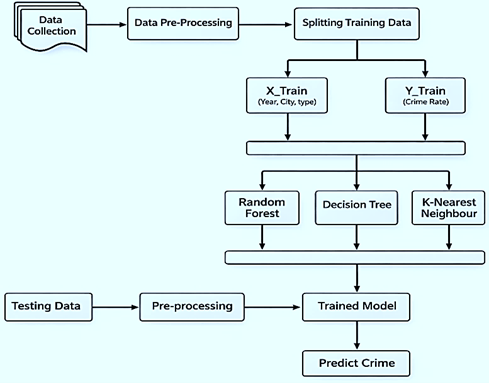
Novelty statement
This framework introduces a multidimensional analysis of Indian NCRB data, optimizing random forest ensembles to predict city-specific crime trajectories.