

 Open Access||Research Article
An AI-Based Menu-Driven Healthcare Chatbot for Underserved Communities
Department of Electronics and Telecommunication, Anjuman-I-Islam's M. H. Saboo Siddik College of Engineering, Byculla Maharashtra, 400008, India
Abstract
Language barriers, low levels of digital literacy, and inadequate medical resources limit people's access to quality healthcare information, particularly in rural and semi-urban areas. In this research study, we present SehatBot, an AI-driven healthcare chatbot that utilizes the WhatsApp Business platform as its delivery vehicle. The goal of SehatBot is to provide multilingual, structured healthcare services in developing regions. Users can ask questions about symptoms they are experiencing, view vaccination schedules, and access health alerts issued by local governments through a user-friendly messaging interface. SehatBot was developed using Flask as the backend framework with a modular architecture. Additionally, it uses webhook technology to communicate with the Meta WhatsApp Business Cloud API, eliminating the need for users to install any additional applications. To provide reliable and context-aware responses, a hybrid NLP approach has been implemented by combining rule-based methods, a menu-driven finite-state mechanism, and optional machine learning-based intent classification. The healthcare knowledge base is stored in JSON format and managed using PostgreSQL in the production environment and SQLite in the development environment. Preliminary evaluations were conducted with 10-15 participants, who reported that SehatBot operated reliably, effectively supported multiple languages, and responded within 0.5 to 1 second. These findings suggest that SehatBot provides a scalable solution for improving health awareness, reducing misinformation, and increasing access to trusted healthcare information in underserved communities.
Keywords
Graphical Abstract
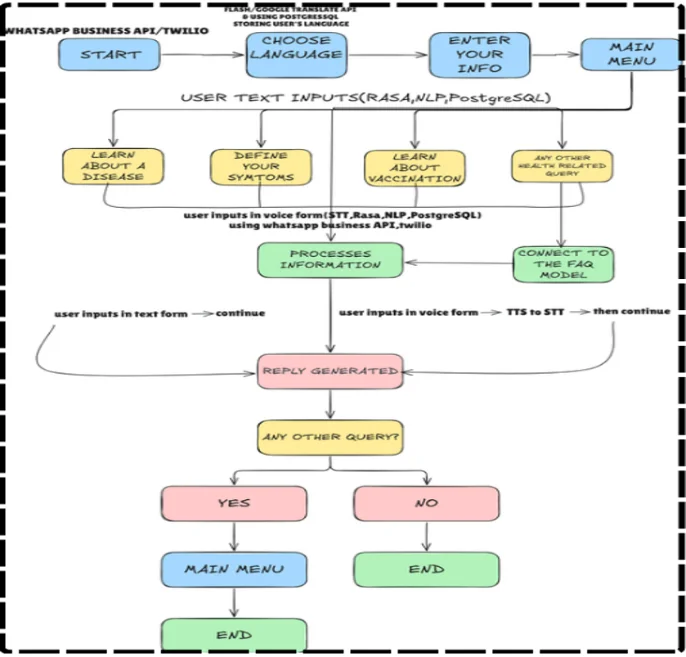
Novelty Statement
This study presents a hybrid AI healthcare chatbot combining rule-based reasoning, finite-state workflows, and NLP to deliver multilingual healthcare support efficiently.
1. Introduction
2. Methodology
3. Results and Discussion
This pilot test had about 10–15 individuals from the development team. Functional correctness, multi-language capabilities to respond to user queries, menu-based navigation and the ability of the system to operate stably and perform reliably under normal operating conditions were tested. Realtime testing occurred using a smartphone device as the client (via WhatsApp) and the server was running in development mode. Automated benchmarking tool(s) were not used – manual observation records were kept. Working Prototype of the System is shown in Fig. 2.
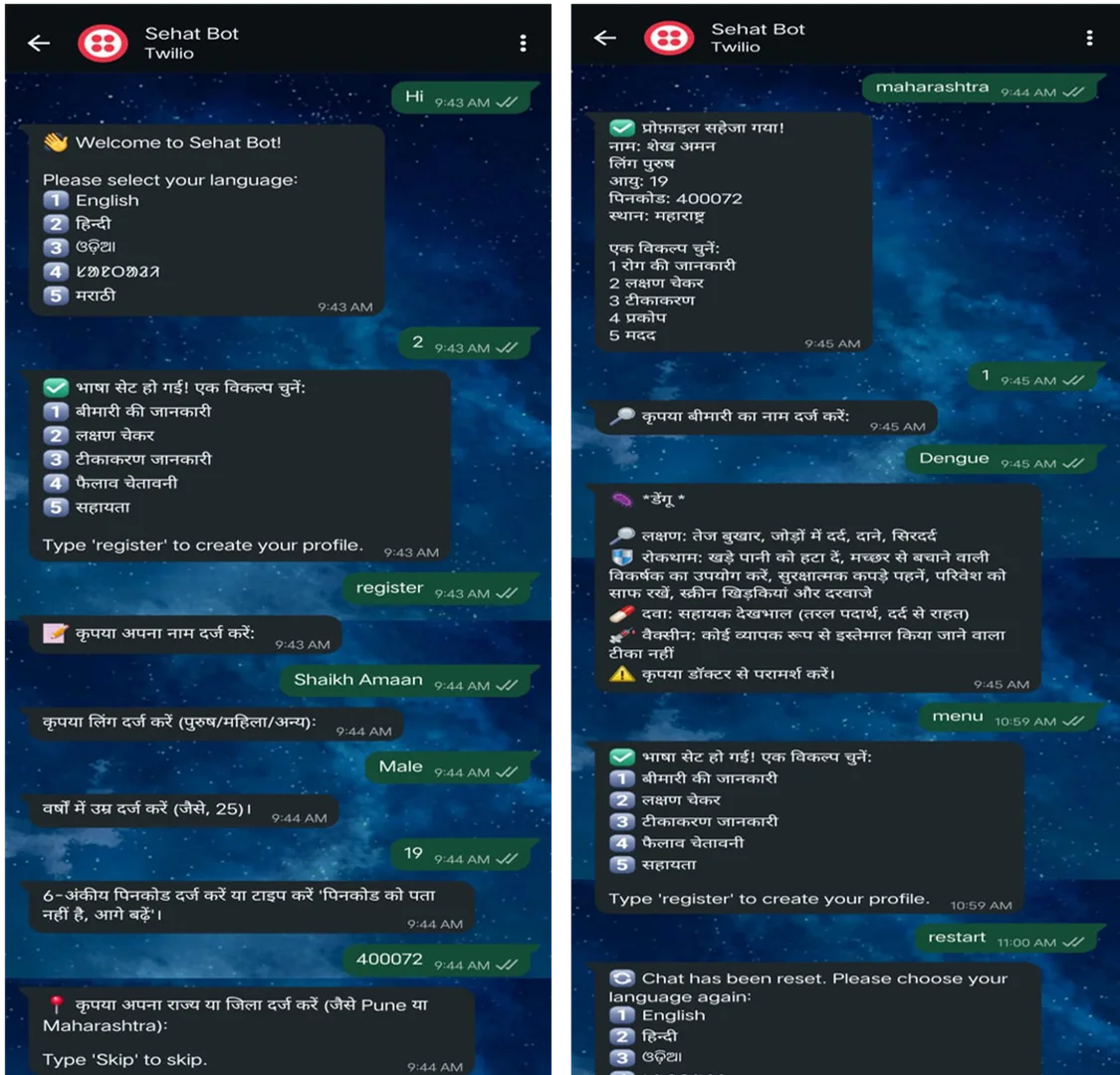
Fig. 2: Working prototype of the system.
The system performed well in all tests that were run. There were no navigational “dead ends” in the workflow of core functions such as accessing disease information and checking symptoms. The Webhook communication pipeline successfully sent and received messages (requests & responses) via the WhatsApp Business API. Average response time per query ranged approximately 0.5 seconds when there were minimal network delays, which is comparable to near real-time interaction that can be practically used.[16] Testing for multiple languages was done in separate sessions. When an individual chose a language for their session, that language choice continued for the entire length of their session. There were no apparent problems with grammar or semantics related to how the system responded back to users. A hybrid translation method was employed where pre-translated medical content was provided with some degree of dynamically translated content, and it served its purpose to provide clarity and reliability while minimizing potential problems with full automation translation. On average, users could find what they needed by asking questions and receiving answers in 2 to 3 iterations. Because the finite state machine-based design of the system defined the order in which things should happen as part of a conversation and/or transaction, it helped create a structure and direction to conversations thereby reducing confusion for users with less experience with digital technology.[1] No failures due to loss of connectivity were experienced during testing but no extreme load testing or very large scale testing has been completed at this point. In terms of being flexible yet consistent, the Hybrid Conversational Model worked well because it allowed for rule-based logic to generate consistent responses as well as allowed for limited Natural Language Processing (NLP) to allow for slight variations in inputs.
From an implementation standpoint the system is planned to be implemented upon lower cost infrastructure using well known communication systems like WhatsApp and SMS therefore decreasing the dependency upon custom applications or high-end user device requirements. A comprehensive feature comparison between SehatBot and existing digital health platforms is detailed in Table 1. The primary cost of operations will be related to message transmission services, back-end infrastructure, and maintenance. The system has been built around a sustainability model that does not charge the end-user; but rather generates income from relationships with health care organizations/providers, service integrations and partnerships with institutions. This strategy provides the necessary resources for the longevity of the system while at the same time allowing for accessibility. However, widespread use of SMS in low connectivity areas could increase operational costs and require optimization. While there have been many benefits, there are some significant limitations. Due to the fact that this study was based on a small number of participants who all worked within the company/organization, this study does not provide results on how the system would perform in a larger scale or in-field testing environment. In addition, since no formal quantitative measures (i.e., accuracy rate, completion times) were collected during testing, it is difficult to compare different types of input (e.g., keyboard vs. touch screen). Currently, the system is only able to send messages over the WhatsApp application and thus comparison data does not exist. In general terms, these results support the concept of utilizing a structurally organized multi-lingual chat bot deployed on a messaging platform to enhance access to quality healthcare information within resource-poor communities.[17] The system achieved its objectives of providing usable functionality, timely responses, and controlling what information is provided to the user while demonstrating potential for scalable and sustainable real-world implementations.
Table 1: Comprehensive feature comparison between SehatBot, MFine, DocsApp and Tata1mg
| Parameter | SehatBot | MFine | DocsApp | Tata1mg |
|---|---|---|---|---|
| Platform Accessibility | WhatsApp-Based (no app installation) | Mobile application | Mobile application | Mobile application |
| Multilingual Support | Extensive (English, Hindi, Odia, Regional languages) | Partial | Limited | Partial |
| Support for low Digital Literacy | Menu-driven interaction | Limited | Limited | Limited |
| Disease Information and Awareness | Available | Available | Available | Available |
| Symptom based Disease Guidance | Available | Available | Available | Available |
| Vaccination Schedule Guidance | Available | Limited | Not Available | Partial |
| Government Health-Data Integration | Available (IDSP, MoHFW) | Not Available | Not Available | Not Available |
| Public Health Outbreak Alerts | Available | Not Available | Not Available | Not Available |
| Primary Healthcare Focus | Preventive healthcare and awareness | Online consultation | Online consultation | Pharmacy and consultation |
| Cost to End User | Free | Consultation charges apply | Consultation charges apply | Basic service free (Consultation charges apply) |
4. Conclusion
SehatBot was a messaging-based chat bot created as part of this research project to help provide access to structured/reliable health care information in low resource areas. To ensure both consistent and usable responses from the chat bot a hybrid conversation model was developed combining three different approaches including; Rule-Based Logic (RBL) Finite State Machine (FSM) Interaction Limited Natural Language Processing (LNLP). By using the WhatsApp platform to deploy the chat bot, the researchers were able to leverage an existing common mode of communication which would assist in reducing barriers to adoption. An internal pilot level assessment indicated that the system performed well under normal operating conditions provided effective multilingual functionality and produced near real time results. Additionally, because of the use of a structured, menu driven approach to designing the user interface, users are better able to navigate through the application and avoid confusion which can be a challenge for many who have limited digital experience. Although there has been some evidence of success identified as part of this research, there are limitations related to this study. Due to the nature of this being an internal pilot level assessment with a relatively small number of participants, the researchers did not include a larger scale or external quantitative analysis. Therefore, future research will need to investigate how to deploy the system at a wider scale, integrate the system into multiple platforms and create performance metrics that allow researchers to assess the effectiveness of the system. In general, this research provides evidence that using structured chat bots may be one way to increase access to healthcare information in communities with limited availability of traditional sources of information.
CRediT Author Contribution Statement
Mohammed Abbas Sayyed: Conceptualization, Methodology, Software, Validation, Investigation, Data curation, Visualization, Writing – Original draft. Amaan Shaikh: Conceptualization, Methodology, Software, Validation, Investigation, Data curation, Visualization, Writing – Original draft. Shrushti Sapte: Conceptualization, Methodology, Software, Validation, Investigation, Data curation, Visualization, Writing – Review & editing. Zara Shaikh: Conceptualization, Methodology, Software, Validation, Investigation, Data curation, Visualization, Writing – Review & editing. Yumna Qureshi: Conceptualization, Methodology, Software development, System implementation, Validation, Investigation, Data curation, Visualization, Writing – Original draft. Awij Shaikh: Conceptualization, Methodology, Software, Validation, Investigation, Data curation, Visualization, Writing – Review & editing. All authors participated in the design and development of the SehatBot prototype, reviewed the manuscript critically for important intellectual content, approved the final manuscript, and agree to be accountable for all aspects of the work. All authors have read and agreed to the published version of the manuscript.
Data Availability Statement
The datasets and implementation details supporting the findings of this study are available from the corresponding author upon reasonable request.
Conflict of Interest
There is no conflict of interest.
Artificial Intelligence (AI) Use Disclosure
The authors declare that artificial intelligence (AI)-assisted tools were used only for language refinement, grammar improvement, and manuscript structuring purposes during the preparation of this work. All technical content, experimental implementation, results, and interpretations were independently developed and verified by the authors.
Supporting Information
Not applicable.
References
- [01] L. Laranjo, A. G. Dunn, H. L. Tong, A. B. Kocaballi, J. Chen, R. Bashir, D. Surian, B. Gallego, F. Magrabi, A. Y. Lau, E. Coiera, Conversational agents in healthcare: a systematic review, Journal of the American Medical Informatics Association, 2018, 25, 1248–1258, doi: 10.1093/jamia/ocy072.
- [02] B. A. Shawar, E. Atwell, Chatbots: are they really useful?, Journal for Language Technology and Computational Linguistics, 2007, 22, 29–49.
- [03] A. M. Turing, Computing Machinery and Intelligence (1950), Mind, 1987, 59, 33–60, doi: 10.1093/oso/9780198250791.003.0017.
- [04] J. Weizenbaum, ELIZA—A Computer Program for the Study of Natural Language Communication Between Man and Machine, Communications of the ACM, 1983, 26, 23–28, doi: 10.1145/357980.357991.
- [05] A. Vaswani, N. Shazeer, N. Parmar, J. Uszkoreit, L. Jones, A. N. Gomez, L. Kaiser, I. Polosukhin, Attention is all you need, Advances in neural information processing systems, 2017, 30, doi: 10.48550/arXiv.1706.03762.
- [06] T. Bickmore, D. Schulman, L. Yin, Maintaining engagement in long-term interventions with relational agents, Applied Artificial Intelligence, 2010, 24, 648–666, doi: 10.1080/08839514.2010.492259.
- [07] Pallets Projects, Flask: A Lightweight WSGI Web Application Framework, 2023, https://flask.palletsprojects.com/en/stable/, Accessed 15 April 2026.
- [08] Meta Platforms, Inc., WhatsApp Business Platform Documentation, 2023, https://developers.facebook.com/documentation/business-messaging/whatsapp/overview, Accessed 15 April 2026.
- [09] Twilio Inc., Twilio API for WhatsApp, 2023, https://www.twilio.com/en-us/messaging/channels/whatsapp, Accessed 15 April 2026.
- [10] NGINX, Inc., NGINX Documentation, 2023, https://nginx.org/en/docs/, Accessed 17 April 2026.
- [11] Gunicorn: Python WSGI HTTP Server, 2023, https://gunicorn.org/, Accessed 17 April 2026.
- [12] Docker Inc., Docker Documentation, 2023, https://docs.docker.com/, Accessed 19 April 2026.
- [13] Rasa Technologies GmbH, Rasa: Open-Source Conversational AI Framework, 2023, https://rasa.com/, Accessed 20 April 2026.
- [14] SQLite Consortium, SQLite Documentation, 2023, https://sqlite.org/docs.html, Accessed 18 April 2026.
- [15] PostgreSQL Global Development Group, PostgreSQL Documentation, 2023, https://www.postgresql.org/docs/, Accessed 20 April 2026.
- [16] Google LLC, Google Cloud Translation API Documentation, 2023, https://docs.cloud.google.com/translate/docs/reference/rest, Accessed 21 April 2026.
- [17] M. Honnibal, spaCy 2: Natural language understanding with Bloom embeddings, convolutional neural networks and incremental parsin, 2017, https://sentometrics-research.com/publication/72/, Accessed 20 April 2026.
© The Author(s) 2026