

 Open Access||Research Article
An AI-Driven Training and Placement Platform with Predictive Analytics and Conversational Assistance
Department of Computer Engineering, Keystone School of Engineering, Pune, Maharashtra, 412308, India
Abstract
The increasing volume and diversity of student performance data have exposed significant limitations in traditional training and placement systems, which primarily rely on static eligibility criteria, manual shortlisting processes, and delayed communication mechanisms. These systems lack the ability to leverage predictive analytics, resulting in limited personalized, data-driven insights to enhance student employability based on individual skills and qualifications. Although several studies have applied machine learning techniques for job applicant ranking, most existing solutions lack real-time integration, interpretability, and conversational support within placement systems. To address these challenges, this study proposes an AI-driven education and placement platform that integrates machine learning-based placement prediction with conversational assistance and intelligent job matching. The system utilizes XGBoost for predictive modeling, Sentence-BERT embeddings for semantic skill representation, SHAP for explainable insights, and Retrieval-Augmented Generation (RAG)-based chatbots to provide real-time guidance and interview preparation support. The platform is implemented using FastAPI and deployed on cloud infrastructure, with automated email notification systems enabling real-time user interaction. The proposed system was evaluated using a dataset of 1,200 student records, incorporating academic, skill-based, and experiential attributes. Experimental results demonstrate an accuracy of 89%, along with strong performance across multiple evaluation metrics, including precision (0.88), recall (0.89), F1-score (0.88), and ROC-AUC (0.88). Additionally, the system achieved low inference latency (<150 ms) and maintained stable performance under concurrent usage conditions. Overall, the findings indicate that integrating predictive analytics, conversational intelligence, and scalable system architecture significantly enhances placement decision-making, improves student guidance, and enables institutions to adopt a more efficient and data-driven approach to managing placement processes.
Keywords
Graphical Abstract
Novelty Statement
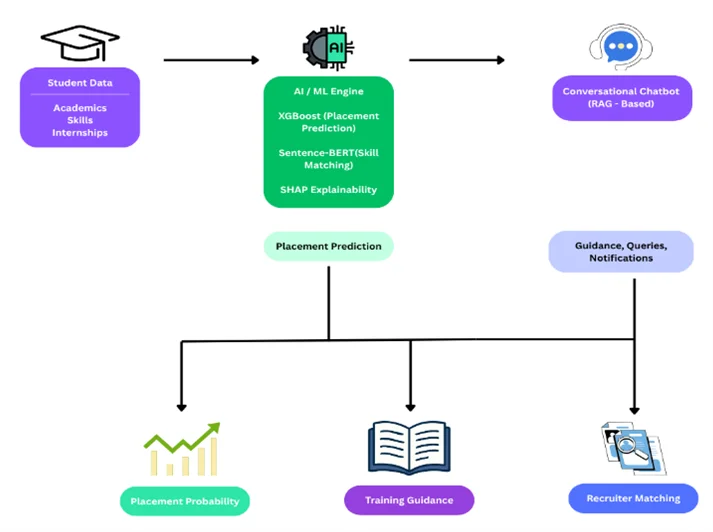
An integrated AI-driven placement platform combining predictive analytics and conversational assistance to enable real-time, scalable, and data-driven decision-making in institutional training and placement systems.
1. Introduction
Digital placement portals in colleges and universities are now common but are largely limited to administrative functions.[1] They mainly focus on record-keeping, eligibility filtering, and displaying job announcements for students and employers. However, these systems lack analytical capabilities to predict student performance or hiring outcomes based on available data.[2] Typically, this means that placement is related to static minimum academic standards and manual judgment from an administrator, resulting in a limited ability to quickly respond to changing patterns of recruitment and skill requirements.[3,4] The rapid growth of data-driven technology and machine learning has changed the way we look at education. It provides educators with tools that allow them to intelligently analyze and interpret vast amounts of data about students so that educators can better personalize learning experiences for each individual. Recent studies confirm that many schools are implementing AI-based educational systems as a result of greater demand for adaptive learning environments and data-informed management within institutions.[5] In addition, compared with traditional statistical analyses, machine learning methods are effective at identifying patterns, predicting outcomes, and improving educational results.[6] The challenge for educators is to more fully incorporate machine learning into their existing placement systems for students in the workforce.[7] In an average institution, dozens to hundreds of students undergo placement processing at once (if not thousands), often without any form of intelligence-based solution or analytical ability, resulting in placement processing being performed manually or with static rules more than Seventy percent of the time. As an example, eligible filtering, job matching, and student shortlisting all suffer from inconsistencies and delays. In addition, the absence of any predictive modeling means that at-risk students cannot be identified before they are too late and therefore not provided with adequate recommendations for personal development training. With growing amounts of data being processed through placement systems, the deficiencies experienced in present-day placement systems will only increase.[8] Therefore, scalable systems using artificial intelligence to provide adaptive decision-making with real-time analysis will need to be developed to meet these needs.
Previous research has indicated that supervised machine learning placement predictions are moderately to very accurate when they are based on historical student data.[9,10] However, many of these studies involve only offline experiments using created datasets and have not been applied to actual operational placement systems. Because of limited resources, many of these issues will be examined, such as real-time inference, data drift, the incorporation of institutional workflows, and user interaction. Most predictive models tend to operate independently, without a means to communicate, so that the analytical results can provide meaningful guidance to students and administrators.[11,12] A key limitation of current placement systems is that they do not have conversational and/or interactive support systems to help with real-time queries and lower administrative overhead. Although web-based portals help to share information in a centralized manner, they usually rely on asynchronous communications (e.g., email), thus causing delays in communication and inconsistent distributions of placement-related information.[13] From the perspective of software system evaluation, there is also a major research gap in that there is no analytical component that is integrated into the overall assessment of placement-related services through both the use of interaction-based measures and the assessment of deployment by users.[14] The present study examines how this research gaps can be resolved by evaluating the implementation and performance of a fully integrated functional placement system using empirical approaches as opposed to design-centric approaches. The major contribution of this work is the experimental evaluation of the performance of a machine learning-powered predictive pipeline for predicting placement, which functions within a working integrated placement system and is enhanced by interaction through conversation. Instead of proposing new conceptual architectures, the current research evaluates real-world data to evaluate the predictive accuracy and system performance and the feasibility of the practical use of integrated AI-based placement systems. This aim is to establish an evidence base for the performance of AI-based integrated placement systems under real-world conditions, thereby creating a connection between predictive modeling research and deployable educational technology solutions.
1.1 Overview of placement systems
The placement process serves as an important connection between academia and industry recruiters. Historically, placement cells have used manual methods or simple database systems to compile students' data and periodically update their eligibility lists and matching details.[3] While a number of universities have moved to web-based portals for training records and recruitment calendars, most still act only as data repositories instead of providing intelligent decision-support tools.[4] These systems also serve their limits via record storage, document uploads, and communication notifications via email. The systems do not make use of the great amounts of student data collected over countless academic years and thus have not applied predictive or analytic processes to the data.[9] The recent digital shift in higher education has prompted the adoption of learning management systems (LMS) and online assessment tools that yield useful performance data.[10] Unfortunately, these data are often disconnected from placement databases, limiting their use in employability analytics.[11] Studies, such as those in [6] and [7], have recommended that centralized placement management systems need to transition from a static database to an intelligent platform that generates insights that can be actioned by students, faculty members, and recruiters.
1.2 Need for AI-driven automation
The growing volume of student data and the evolving nature of corporate hiring trends have rendered manual placement management systems inefficient and error prone.[1] With thousands of students applying to multiple companies every semester, placement coordinators face difficulties in managing eligibility criteria, schedules for interviews, and communications with recruiters in real time. [2] More traditional methods require continuous manual updating and verification of placement processes, which reduces the accuracy of the data and the administrative workload. As discussed in [11], most existing web-based platforms lack predictive insights or adaptive learning that can study placement patterns and outcomes and constantly predict placement success.
Artificial intelligence (AI) and machine learning (ML) technologies have shown great promise in changing data-driven decision-making. They allow organizations to look for insights in historical datasets and detect trends that conventional analysis cannot identify.[12] For instance, supervised learning algorithms such as support vector machines (SVMs), random forests, and logistic regression consistently demonstrate efficacy in predicting student performance and employability.[13] These models are capable of evaluating factors such as academic results, technical skills, internship experience, and certifications to predict a student's probability of being placed. In addition, automation through AI-powered chatbots and recommendation engines will provide students and recruiters with timely assistance, and roles are shifting to more rapid communication and increased engagement.[15] The introduction of these systems to placement reduces manual dependency, increases accuracy, and enables scalable placement across institutions. Automated systems, which use AI, evolve the placement system from simply a data-management tool to become an intelligent ecosystem capable of making proactive decisions that align student skillsets with industry needs.
1.3 Limitations of traditional approaches
Although traditional placement systems are commonly used in academic institutions worldwide, they present a considerable number of constraints that impact efficiency, effectiveness and scalability. Most importantly, placement systems operate as manual or semiautomated record-keeping systems focused on data storage and retrieval[11] without incorporating intelligent aspects, such as predictive analytics or pattern recognition, needed for understanding trends in student employability and outcomes. Thus, academic institutions are often unable to identify skills gaps or be proactive in delivering training opportunities to students who are underperforming.[12] Second, traditional systems rely on administrative support to help verify eligibility, shortlist candidates, and update records after a recruitment cycle.[13] In addition to being very time-consuming, all of these tasks run the risk of errors, inconsistencies, and delays in communicating with companies. Furthermore, these systems do not integrate training, performance analytics, or placement outcomes, leading to data fragmentation for management purposes.[15] A significant drawback is the limited dynamic adaptability. Traditional systems are not designed to accommodate the current rapidly evolving recruitment and skill-based assessment processes introduced by the industry. [16] For example, most platforms do not have real-time analytics or personalized feedback for students, depending on company requirements. Furthermore, the majority of current placement management systems lack the ability to perform other advanced authentication methods. Therefore, there is potential for issues with the recruitment and data security and privacy of students in terms of information related to placement agencies or tools.[11] These challenges illustrate the need for an intelligent, secure, and adaptive AI-driven solution to optimize operations, support prediction accuracy, and provide a systemic view of student readiness to transition into employment.
1.4 Motivation for the proposed system
The escalating challenges posed by campus recruitment and the increase in employer demand for employability-ready graduates signifies the need for a smart, flexible, secure, and integrated placement framework.[13] Institutions are seeking systems that not only store placement data securely and efficiently retrieved from different sources but can also help draw insights and help guide students and employers. The concepts of artificial intelligence (AI) and machine learning (ML) now enable institutions to automate key decision-making processes and move placements in a predictive, interactive model as part of the placement management experience.[15] The rationale for the AI-Powered Training and Placement Portal is based on the notion that all of the functions-student profiling, placement prediction, skill analysis, and communication-are two features integrated within one platform. Current models provide some partial resolution intended either for data storage or for analytics; however, very few have included an end-to-end intelligent ecosystem.[16] The described system combines the power of ML algorithms with assessments of prior academic data, analyzed training performance, and recruiter feedback to predict students' likelihood of placement. On the basis of this prediction, the system may also recommend personalized training or certification programs to maximize employability outcomes.[17] Coupled with the integration of a chatbot, interface access is supported by immediate responses to student enquiries, notifications of eligible opportunities, and continuous communication with the placement officer. [18] This integration is holistic and allows both the student and administrator to experience cohesive, data-driven and interactive placement. In addition to automation, the system addresses concerns of data credibility, transparency, and recruiter trust, which are increasingly important in the wake of fake job postings and unverified recruiters.[16] Consolidating all placement activities, as well as including data validation features, will help ensure greater trust and accountability among stakeholders. Therefore, the paired use of predictive modeling, an interactive chatbot, and secure data management provides the basis for this research, embodying a disruptive approach to leading modern education.
1.5 Research motivation and objective
The rationale for conducting this research stems from a growing dissociation between the availability of comprehensive student data at the level of institutional operations and its limited use in actual placement decisions at the institutional level. Institutions are turning to more digital platforms; however, they continue to use reactive and manual processes that do not utilize predictive information to improve student success. Additionally, with the accelerated pace of change in terms of industry requirements and increased competition for campus hiring, there is a dire need for systems that not only produce predictive analytics to forecast whether candidates will meet placement expectations but also provide personal data-driven, proactive interventions to assist students through their own individual career placement cycle. This study is therefore driven by the need to develop and test a combined, integrated, operational, intelligent placement system that uses predictive analytics, explainable decision-making, and real-time conversational support. The primary objective of this study is to close the gap between stand-alone machine learning models and applicable placement systems by demonstrating the viability, scalability, and success of an AI-based solution for real institutional settings.
2. Existing/similar work on training and placement systems
The integration of artificial intelligence (AI) and machine learning (ML) into placement management systems has garnered attention as an emerging research space, with various models addressing predictive analysis and automation in relation to student employability.[19,20] However, the scope of most candidate systems reviewed is narrow with respect to the overall placement process, whether through academic analytics or a focus of either communication management or registration management with placement systems. While this emergent area is being developed, a holistic framework with prediction, training and automation that links the capabilities across functions within one intelligent portal is conspicuously absent in placement management systems.[21] Therefore, it seems appropriate to discuss the need for a truly complete and integrated adaptive solution to enable effective intelligent management of the complete placement life cycle from data analysis to student engagement.
2.1 Machine learning-based placement prediction models
Applications of machine learning (ML) in predicting student performance and placement have grown from its vast potential to analyze large datasets and find patterns that would otherwise be undiscovered. [22] Research has investigated various ML algorithms, such as support vector machines (SVMs), decision trees, random forests, and logistic regression, which all label students as “placed” or “not placed” on the basis of academic backgrounds and skills. [23] Original features were accounted for, such as cumulative grade point average (CGPA), attendance, project experience, and internships, to predict placement and employability.[24] Srimathi et al.[3] used a decision tree-based method to produce classification rules to predict placement likelihood on the basis of academic and technical characteristics. The system produced moderately accurate predictions but was inflexible across institutions with different programs of study. The methods in [11] and [12] similarly used either a random forest or a naïve Bayes model to improve accuracy and accommodate imbalanced datasets. While both sets of methods improved prediction accuracy, they relied on static datasets, requiring manual retraining each time new data were available. Recently, researchers have begun to apply deep learning models to placement prediction, using neural networks to learn from a variety of student features at the same time.[25] Researchers have also begun applying deep learning techniques with advanced feature analysis to predict placement outcomes by utilizing high-dimensional data representations and model interpretability techniques, which enhance both the accuracy and robustness of predictions. In terms of feature importance, feature selection techniques based on explainable AI (XAI), and feature importance selection techniques have demonstrated marked improvements in model performance while maintaining interpretability across multiple data types.[21] While these systems have shown higher accuracy and robustness than traditional models do, they require large labeled datasets and much more computing power.[15] Moreover, most of the reviewed ML-based systems do not function in combination with the relevant institutional placement portal and fail to connect predictive information with practical placement management or communication modules.[16] The results indicate that although models incorporating ML perform well in academic analytics, their disjointedness and inflexibility of use hinder their application in the real world of institutional placement ecosystems. This creates a need for an intelligent framework that incorporates ML prediction and combines it with automation, scalability and real-time decision support.[10]
2.2 Existing training and placement portals
Most educational institutions have built their own digital or web-based placement management portal to simplify administrative work and support data handling.[10] Generally, these systems include modules to register students, post jobs, post company updates, and manage applications through shortlisting workflows. Most such systems still use static logic and do not include intelligent automation.[11] The typical process allows students to fill in personal information, upload their resumes, and select to apply for drives, while recruiters can post job profiles and eligibility information. Typically, these systems have linear and manual data flows between recruiters and students, and not much analytical analytics is built in them.[12] Research identified in [13] and [15] highlights that current portals are primarily information management systems rather than intelligent systems. Information management portals provide offers in terms of managing processes and reducing paperwork by offering the ability to maintain structure and databases, but they do not take advantage of data analytics to predict a student's readiness or job fit. Communication from and between students, recruiters, and placement officers who use the portals generally occurs via emails or announcements, leading to delays or inconsistent information.[16] A further limitation noted in [12] and [15] is the lack of real-time data synchronization and data validation, which can result in problems such as job postings being outdated, duplicate records, or students being listed as eligible when they are not. Most systems also do not provide any safeguarding, creating the possibility of unauthorized access or misinformation about students' education from unverified recruiters.[11] Last, most existing portals do not include features that utilize skill-based recommendations or individualized training paths, creating a streamlined approach to preparing students. While these platforms are key developments in digitizing placement, they are still transactional, relying on operational convenience rather than intelligence; the need for an AI-focused suite of analytics, automation, and interaction to improve placement results while enabling institutional efficiency is increasing.
2.3 Comparative analysis of current solutions
A comparative analysis of existing systems suggests that while several approaches utilize machine learning (ML) or web-based automation to improve the placement process, relatively few holistic solutions demonstrate integrated analytics, communications, and scalability.[11] Systems that focus only on an ML-based prediction model can achieve moderate accuracy but have no practical application in an institutional context.[12] Web-based placement portals that efficiently monitor placement records do not pursue learning algorithms, which limits their usability and ability to predict.[13] As noted in [7], prior placement solutions can be generally identified by three modalities: analytical models, management portals, and hybrid systems. Analytical models typically rely on classification or regression algorithms to predict placement but do not engage directly with a user-facing application. Management portals facilitate the organization of records but remain static and do not offer decision-making capabilities on the basis of the data. Hybrid systems attempt to combine prediction and management, but like existing systems, there is little to no real-time interactive adjustment to a user's input or the context of moving recruitment environments.[16] Moreover, research comparing several models reveals that the majority of placement prediction systems report accuracies ranging from 75–85%, which is contingent upon the algorithm and dataset size.[13] While this is encouraging, the models do not typically have feedback loops or adaptive retraining to improve predictions over time. Similarly, regardless of whether feedback loops or adaptive retraining are used, existing placement portals cannot accommodate multiple concurrent students and recruiters, which creates data inconsistency during peak times.[12] Furthermore, it is clear from their previous research work that the literature review revealed that none of the systems assessed addressed two essential challenges (without repeating, i.e., distinctions that set it apart) faced by the recruitment automated system in the literature review, which are recruiter validity, conversational AI, and personalized learning recommendation within a single integrated platform. [15] The absence of consideration of such a comprehensive approach presents an opportunity to develop a robust AI-powered system that involves the use of recruitment prediction, security, and communication. AI-Powered Training and Placement Portal therefore aims to provide appropriate means for joining the gaps with a model using ML-based predictive models or apps with chatbot engagement and centralized data to provide improved transparency and workflow efficiency.[4]
If these gaps are addressed, a more robust, scalable, and adaptable intelligent placement system can be developed to effectively support data-driven decision-making and improve overall placement outcomes. Through a thorough gap analysis of current systems, it has become clear that most of these solutions operate independently and lack interoperability, falling short in their three key areas of prediction, management, and communication. There is an absence of analytical models (i.e., focus on accuracy of classifications) that have been developed for implementation in a true real-world environment (i.e., practical use). On the other hand, many of the current web-based placement portals provide some useful administrative functionality; however, none of the deployment architectures possess predictive/analytical capabilities or have been designed to learn and adapt over time. Hybrid models have been developed as attempts to bridge this gap. Unfortunately, these hybrid systems often lack real-time means of interaction between users and the system (i.e., real-time), provide little or no method of explaining how the decisions were made (i.e., explainability) and lack a scalable deployment model for concurrent users (i.e., scalability). The proposed system combines predictive analytics (i.e., an analytical model that uses XGBoost), semantic understanding of skills (i.e., Sentence-BERT embeddings), explainable AI (i.e., SHAP values for explaining how the AI decision was made) and real-time conversational support via a retrieval-augmented generation chatbot all into one comprehensive platform. Additionally, unlike existing solutions (both analytical and administrative), the proposed architecture enables real-time job matching, personalized recommendations, and a scalable deployment model that allows for concurrent usage. This integrated model addresses all of the main limitations of current systems found within previously conducted research and therefore provides an all-inclusive, practicable AI-based placement ecosystem.
3. Challenges in training and placement systems
Although the use of digital placement management tools continues to grow, the effectiveness and scalability of many of these tools are limited by various challenges. While some digital placement systems provide data storage and record management, few systems provide any analytical information related to student employability trends.[3] In addition, many digital systems are not agile enough to accommodate constantly shifting industry requirements and skill expectations.[4] As placement operations become even more complex (with hundreds of students and dozens of recruiters-along with an abundance of real-time data), the shortcomings of placement management tools become even more pronounced.[9] These issues may decrease efficiency and disallow institutions from using data-based decision-making to positively affect placement.[2] A comparative analysis of existing training and placement systems with respect to prediction accuracy and automation capabilities is presented in Table 1.
Table 1: Comparative analysis of existing training and placement systems on the basis of prediction accuracy and automation capabilities.
| Approach [Ref.] | Focus Area | Prediction accuracy | Limitations |
|---|---|---|---|
| System [10] | Academic performance analysis | 78% | Static dataset; manual updates required |
| System [11] | ML-Based placement prediction | 82% | No real-time data integration. |
| System [12] | Web-Based placement portal | -- | Limited automation; lacks analytics |
| System [15] | Hybrid prediction model | 85% | No chatbot or adaptive feedback mechanism |
| Proposed system | AI + Chatbot Integrated placement portal | 89% | -- |
3.1 Data Management and Scalability
With every year that passes, an increasing number of students, recruiters, and placement activities are taking place on each campus. Institutions are seeing it becoming increasingly difficult to maintain data integrity and performance efficiency and to complete these placement activities.[3] Some of these legacy systems rely on either local databases or spreadsheets that require frequent manual updates, which leads to duplicate and disparate data entries.[4] There is no effective centralized data handling and no automation for retrieving and/or analyzing placement records that can support institutions during the recruiting season.[9] Scalability poses a major challenge when hundreds of students and recruiters try to use the portal at the same time. Most existing portals crash, freeze, or experience data conflicts when users simultaneously attempt bulk entries, check registrations, or update data in real time.[10] Many of these systems do not include appropriate backup and recovery solutions to prevent data loss or corruption.[11] The inability of systems to successfully scale in terms of both storage and the number of users accessing or updating the same type of information not only contributes to the diminished reliability of the system but also lowers users' trust in web-based placement tools as a whole.
Automated data preprocessing, cloud integration, and distributed database management offer solutions to these challenges through AI-based solutions.[12] These methods allow organizations to handle large amounts of data seamlessly while managing consistency and availability. The incorporation of scalable architectures allows the system to grow spatially in institutional growth without sacrificing performance to provide the basis for an intelligent and robust placement management environment. The system proposal is built upon the premise of appropriate support for several types of deployment (scalability and generalization). The backend architecture (FastAPI-based service layer + cloud-enabled PostgreSQL database) sufficiently handles concurrent requests from users during peak placement times. The horizontal scalability of the system is the result of the design of the system architecture in a modular manner such that the prediction engine component, the chatbot interface component, and the database layer can all be independently scaled. Because the prediction of placements is carried out using XGBoost, the model has the expected ability to generalize well to heterogeneous student datasets because it effectively captures the nonlinear relationships among the many features of high dimensionality (i.e., numerical, categorical and embedded text). Furthermore, by using embedding-based representations from Sentence-BERT, the possibility of generalizing to different skill description employment types and job requirements is increased. Thus, the combination of architecture and modeling decisions results in a system that provides a robust, scalable, and transferable infrastructure to many types of institutions regardless of the difference in the distributions of their respective data and their placement dynamics.
3.2 Lack of predictive and analytical capabilities
An important downside of traditional placement management systems is that they do not have intelligent prediction or analytical modules to read students' background data to find meaning.[10] Most existing systems look at data primarily for administrative data entry purposes to determine what to register students for and if they are eligible[11] or not for decision-making or predicting employability. This also means that institutions are basing readiness in the recruitment process only on past placement outcomes or static academic criteria and risk being inaccurate or outdated.[12] Artificial intelligence (AI) and machine learning (ML) technology provide robust analytic potential that allows us to uncover hidden patterns in student data, such as the relationships among academic performance, skill level, and placement success.[13] It is incredibly rare for these analytics to be utilized in institutional placement systems. Placement officers cannot take an active role in identifying at-risk students or personalized training recommendations without some sort of predictive model. In addition, recruitment is limited in its ability to quickly shortlist a suitable candidate who best meets their skill requirements without any analytics or screening.[15] Furthermore, institutions' inability to deploy visualization dashboards and trend analysis limit their ability to monitor key longitudinal performance metrics such as skill improvement, training productivity, and placement conversion rates.[16] This leads to an almost entirely reactive position rather than a proactive approach to student success. By adopting AI-enabled analytics, institutions can improve their ability to evaluate placement probabilities and develop an understanding of changing job market trends to ensure that training is consistent with job market expectations.
3.3 Communication and coordination challenges
Effective communication is at the heart of an effective training and placement process. However, the majority of organizations still utilize manual or semiautomated communication methods such as emailing notifications to students, issuing circulars, or simply posting new information on a notification board.[11] This is a reason for delays in communication, missed opportunities, or simple disruptions in communication between students and recruiters and placement coordinators.[12] For example, students are often notified late about company requirements, eligibility, or their interview time. This results in confusion and a lack of interest when their time arrives for a recruitment drive with the company. [13] Another problem arises when communication occurs through a variety of platforms. Students may be required to use email to register, a messaging platform for communication updates, and a separate portal for uploading documents; these platforms communicate that separate entities and organizations can easily increase complexity, leading to miscommunication.[15] When there is no seamless matching interface, placement officers must manage well more than two hundred student queries manually each day, which will require considerable time and effort. This reliance on human interaction often creates bottlenecks for even larger recruitment events. Additionally, in most conventional systems, real-time query resolution cannot be achieved. When students have questions about a company's eligibility, profile requirements, or training program format, they are dependent on placement officers to answer their questions, and this adds ineffectiveness and delay.[16] An AI-based chatbot interface helps eliminate those issues by providing 24/7 assistance, automating answers to repetitive common queries, and delivering consistent information. This reduces the burden on the administration and increases the level of engagement and accessibility across all stakeholders.
3.4 Concerns of security and authenticity
As the prevalence of online placement portals and electronic recruitment procedures increases, the issue of data security and validation is becoming a priority for educational institutions.[12] There are now various online applications used to store sensitive student data on databases that are frequently not encrypted or controlled.[13] Therefore, data breaches, unauthorized access, or misuse are possible. Furthermore, no adequate authentication layers exist in many long-standing placement systems for recruiters, providing room for fake or fraudulent job postings.[15] Over the past few years, there have been a number of cases in which unverified companies have taken advantage of online portals to either collect student data or request payments under the guise of recruitment.[16] These recruitment scams erode institutional credibility and result in students losing trust in the placement process. A significant challenge is the lack of audit logs or traceability capabilities that can be used to monitor user activity and identify unusual activity. [17] To mitigate these risks, placement systems must incorporate best data protection practices such as encryption, role-based access, and recruiter validation.[18] In addition, AI and ML can support the security of the system by flagging unusual login activity or inappropriate behavior of recruiters in real time. In other words, a secure and transparent framework is critical for ensuring credibility, trust, and fairness in the placement ecosystem.
3.5 Ethical considerations and bias mitigation
The use of machine learning algorithms in supporting employees' career placement decisions can pose some risks regarding fairness, bias, and ethical data use. Several mitigation strategies have been incorporated into the system to address these issues. The first strategy is that instead of providing a single or ranked prediction for placement decision-making purposes, it instead provides placement probability estimates, resulting in final decision-making for individual humans and reducing automated bias during the decision-making process. We utilize SHAP's explanation approach to provide a quantitative representation of how each feature (e.g., academic background, skill level, and experience) contributes to the predicted output of the model, providing an avenue for transparency and interpretability in the decision-making process of our model. As a tool for feature importance analysis and model interpretation, SHAP has been effectively used across both supervised and unsupervised learning frameworks to determine which features are influential but not negatively affect model accuracy.[26] Next, sensitive attributes such as gender, caste, or socioeconomic status are not included as features for predictive purposes, further promoting fairness in predictions made through this system. Finally, the domain alignment and job matching modules are built to provide guidance and not eliminate students from being offered career placements, thereby creating a system that promotes equal opportunity among students. These design choices result in a more ethical, transparent, and accountable placement framework based on AI technology.
4. Proposed methodology
4.1 Dataset description
The dataset utilized within this research is from means of one of Kaggle's public datasets. The title of dataset is “Engineering Student Journey” and consists of over 1200 student records with significant detail about their academic performance and technical skill level, in addition to their internship and placement results. The complete dataset includes individuals from three different branches of engineering (Computer Science, Electronics, and Mechanical Engineering), which provides for a broad range of representational characteristics of student profiles. The dataset includes numerical and categorical attributes and contains semester-wise GPA, average GPA, total number of backlogs, and total percentage of attendance, internship experience and participation in extracurricular activities like technical clubs. The dataset also includes skill-based features, i.e., programming languages (Python, Java, and C++) and domain knowledge (Machine Learning, Data Science). The dataset has two attributes that relate to placements: placement status and offered salary (CTC in LPA). These two attributes can be categorized as the most important attributes for employability. This research will use the placement status (will find employment or not). Thus, this will be a supervised binary classification model. In preparation for training the models, the dataset went through pre-processing by removing the null values, normalizing numeric features and encoding categorical variables. Additionally, skill descriptions provided in a text format were converted into dense embedding representations with the use of Sentence-BERT to capture semantic relationships of those skills concerning job descriptions. The dataset provides a realistic and structured representation of student academic progress and career outcomes, making it suitable for evaluating machine-learning models in placement prediction tasks.
4.2 Predictive analytics and student profiling
In the new system's overall workflow, there are four parts of the project: the data collection phase, the data processing phase, the prediction phase, and the user interface/interaction phase. The first step is to collect information about students from institutional databases, which includes academic history, technical skills, internships (if applicable), and extracurricular activities. The next step is to perform data preprocessing, which consists of normalizing numerical feature columns, encoding categorical feature columns, and transforming textual feature columns (such as skill and experience descriptions) into their dense vector representations using Sentence BERT embeddings. The final processed feature set is then passed to the machine learning prediction module, where an XGBoost classifier produces the probability of placement for each student. The predictions produced by the prediction module are then utilized by the job-matching engine to identify relevant opportunities for each student on the basis of semantic similarity to the opportunities posted within the system's database as well as domain alignment with career paths of the students whose data were submitted to the system. Moreover, the chatbot interface provides users with real-time assistance, the system continuously updates current placement records, and the system sends out automated notifications when placements are made for students. This creates an integrated process for prediction (through the prediction module), recommendation (through the job-matching engine), and communication (via the chatbot or automated notifications) as part of one unified platform.
4.3 Mathematical model
The model for predicting placements is described as a supervised binary classification problem, where the input feature vector for each student is defined as follows:
X = {x1, x2, x3, ..., xn} (1)
The input features all relate to academic achievements, individual abilities, experience acquired through internships and so forth. The function that XGBoost will produce for the prediction can be expressed as an ensemble of decision trees:
f(X) = Σk=1N Tk(X) (2)
where Tₖ is the kᵗʰ decision tree, and the output of the ensemble of trees is passed through a sigmoid function to produce a probability score that indicates whether the user will be placed.
P(placement) = 1 / (1 + e-f(X)) (3)
To match students to jobs, semantic similarity can be obtained by using the cosine similarity between the skill vectors of students and the job descriptions.
Similarity = cos(Estudent, Ejob) (4)
where E_student and E_job are embedding vectors that have been generated by Sentence-BERT. To calculate the final matching score, we use the following equation:
Match Score = 0.7 × Similarity + 0.3 × Domain Alignment (5)
These formulas serve to present the predictive and recommendation functions of the proposed system in a mathematical manner.
5. Possible approaches to overcome these challenges
The problems that are evident with conventional training and placement systems suggest that there is increasing demand for an intelligent, scalable and secure option. In response to these issues, researchers have suggested the adoption of artificial intelligence (AI), machine learning (ML) and automation frameworks as part of the institutional placement process. These types of technologies are utilized to provide insights into data analytics, predictive modeling, and adaptable learning mechanisms that assist institutions in discerning trends and making informed decisions. AI-assisted models are capable of analyzing large quantities of past students' data, discovering meaningful patterns, and predicting employability outcomes with a high degree of accuracy. Moreover, automation via chatbots, cloud-based storage, and predictive analytics alleviates the need for human intervention while maintaining transparency and quickness. A more comprehensive approach to manage the workplace placement ecosystem that serves all stakeholders-students, recruiters, and administrators-would be to combine machine learning algorithms with enhancements in communication and security. The overall system architecture of the proposed AI-powered training and placement portal is illustrated in Fig. 1.
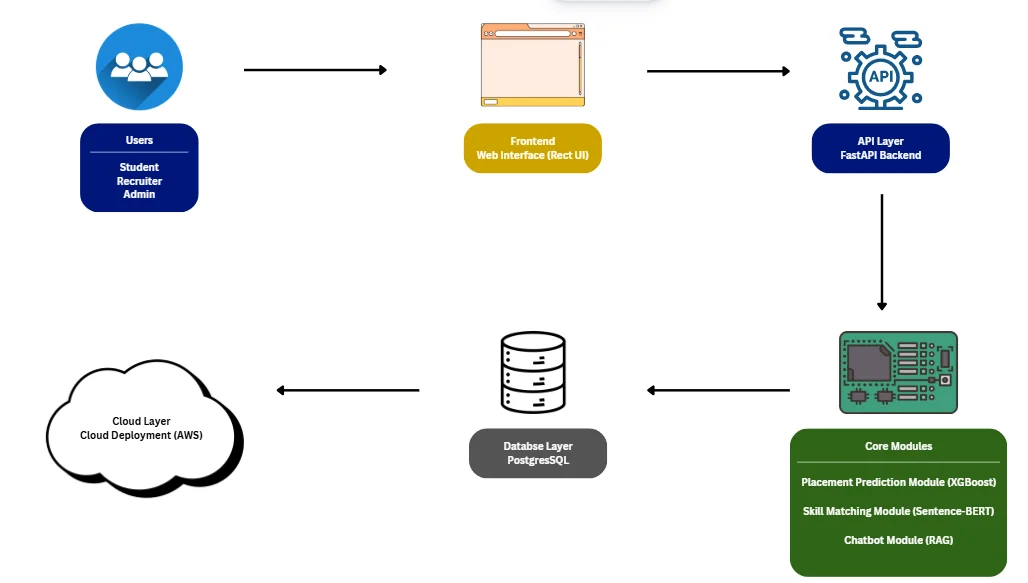
Fig. 1: System architecture of the proposed AI-powered training and placement portal showing the interaction between the user, admin, chatbot, and data management module.
5.1 Predictive analytics and student profiling
A very promising methodology for overcoming the restrictions of traditional placement systems is the implementation of predictive analytics to assess and predict student employability. Predictive analytics is the application of a machine learning (ML) process to historical data to recognize patterns that shape placement outcomes.[4] Attributes such as academic performance, skills proficiency, certifications, extracurricular involvement and internships are scrutinized to determine the likelihood of a student being placed.[9] Algorithms (e.g., support vector machines (SVMs), decision trees, and random forests) have been successfully utilized for the placement prediction of students on the basis of classifications.[10] In these models, correlations between skillsets and employability success are drawn from previously placed and unplaced student records. Following training, the placement probability of students is determined, followed by providing recommendations on specific ways of improvement.[11] Unsupervised learning approaches (e.g., clustering) can also be used for grouping students who share similar characteristics. Institutions are then able to adapt training programs according to a specific cluster of learners. [12] Student profiling using AI can go beyond statistical data analysis. This technology helps map a dynamic representation of each student's journey and skill development experience measured over time. The system integrates a student's profile or data with new indicators of performance, such as project evidence, certificate evidence, or mock interviews. The platform can then provide tailored reminders on how to upskill or specialize in a particular domain.[13] This adaptive, data-driven approach can help placement departments establish skill gaps sooner and improve their readiness for recruitment, ensuring that every student has the support they need at the right time.
5.2 Chatbot integration for communication and guidance
Introducing a chatbot interface to the training and placement system may enhance communication efficiency, accessibility, and user interaction. Common communication channels (such as emails and notices) may cause delays and misunderstandings during the placement cycle.[2] The AI chat box provides students, recruiters, and placement officers with an interactive, centralized method of exchanging information in real time. [11] Chatbots that incorporate natural language processing (NLP) can understand the user question, generate timely responses, and access educational content to help students register a business, assess eligibility, and schedule interviews.[12] Natural language processing (NLP) enables chatbots to understand what users are asking, provide responses on the basis of their conversation history, and engage with users in real time across several different topics. Research shows that conversational artificial intelligence (AI) platforms improve user engagement and responsiveness in education and service-oriented businesses through the use of interactive communication with the unique identity of the user.[27] Conversational interfaces are dynamic rather than static web pages. Conversational models create a two-way conversation that produces personal, contextual responses for the user. The system can provide proactive updates to students about new job openings, deadlines, and shortlist notifications instead of relying on announcements and even manual outreach via email.[13] In addition to reducing administrative burden and offering 24/7 support,[15] the chatbot can operate as an effective virtual placement advisor in managing the repetitive and frequently asked questions that occupy invaluable time for the administrative staff. One study revealed that when a chat assistant was properly embedded into the teaching system, it was able to increase the user satisfaction, retention of information, and transparency of the institution. [16] The chatbot provides a central component for a more user-driven, interactive, and efficient placement experience for the user and graduates, as it covers communication, guidance, and support, all in one interaction.
5.3 Security and data validation mechanisms
Ensuring the safety and authenticity of data is the utmost priority for the acquisition of trust in any digital system for placement. Placement portals, which contain sensitive data, including student records, academic grades, and credentials for companies, must have sufficient mechanisms in place to safeguard against the disclosure of data access or data misuse.[15] Traditional systems often depend on measures of security that utilize basic authentication, which are straightforward enough that they leave data exposed to breaches or manipulation by cybersecurity threats of any sort. [13] Security models supported by artificial intelligence provide smart and adaptive protection. The models support proactive monitoring of user behaviors, identify abnormal behaviors and discover possible threats (for example, password theft and violations of recruitment behaviors).[15] Moreover, data encryption and role-based access control restrict access to sensitive data to only those authorized to access it while protecting confidentiality and system integrity. AI-supported verification procedures can additionally improve the recruiter verification method, where an algorithm is used to evaluate the legitimacy of recruitment using the registration information of the recruiter, previous sources of recruitment, and the similarity of job content posted.[16] This helps prevent fake companies or job postings from capturing student information. Moreover, regular audits of the database will be conducted along with automated backups to protect against data corruption or loss from accidents.[17] With these intelligent security components built in, an institution can create a trusted digital space that protects user data and increases the confidence of the institution's students to those who recruit them. The combination of AI-based monitoring and validation allows for greater transparency and reliability in these systems overall.
5.4 Integration of cloud-based infrastructure
The adoption of cloud-based infrastructure has become an effective and scalable method for managing the large and dynamic volumes of data associated with training and placement systems.[13] On-premise servers and local storage architectures are often bound by performance constraints, especially with mass data access, registration, or placement drives. Cloud computing offers the capacity for on-demand scalability, allowing institutions to provision resources on the basis of system load and user demand.[15] The ability of cloud computing to scale on demand is what makes it possible for those systems to have the ability to dynamically allocate computing resources on the basis of the demands of the users and the current system load. Cloud-based architecture has also been found in recent publications to have a significant effect on the reliability, fault tolerance and real-time data processing abilities of the overall system, which makes cloud computing a better fit for large-scale, data-intensive applications such as Intelligently Placing Systems. With the transfer of placement management systems to a cloud service, institutions are able to provide high availability, remote accessibility, and quicker data processing.[16] The use of cloud services connecting stakeholders-students, recruiters, and administrators- allows the system to update in real time to ensure everyone is informed of any updates, notifications, or changes in a dataset. Cloud platforms also come with built-in reliability and redundancy features such as automated backup, data recovery and load balancing, which minimize downtime in line with the recruitment process.[17] Cloud infrastructure and AI capabilities of analysis incorporate both distributed computing and storage, which are often necessary for managing the scale of data needed for predictive modeling and student profiling.[18] Cloud capabilities and architectures are experientially flexible, allowing institutions the options for a hybrid deployment that couples local control with scalability across the world. In closing, the cloud environment enhances the current learning environment to a new realm of efficiency, security and scalability as technology evolves and organizations respond to changes that impact educational institutions. The architecture of the system includes several parts that connect to each other to allow users (students/recruiters) to perform real-time placement events. Users interact with the system through a web interface, and the front end communicates with a back end designed using FastAPI with a centralized processing layer (the back end). The back end will utilize various modules, including a module that uses XGBoost, a module that matches skill levels using Sentence-BERT, and a chatbot that uses RAG to converse with users. These modules access a centralized PostgreSQL database. In addition, the entire system is hosted on the cloud infrastructure to enable scalability, reliability, and efficient support for many concurrent users, as illustrated in Fig. 2.
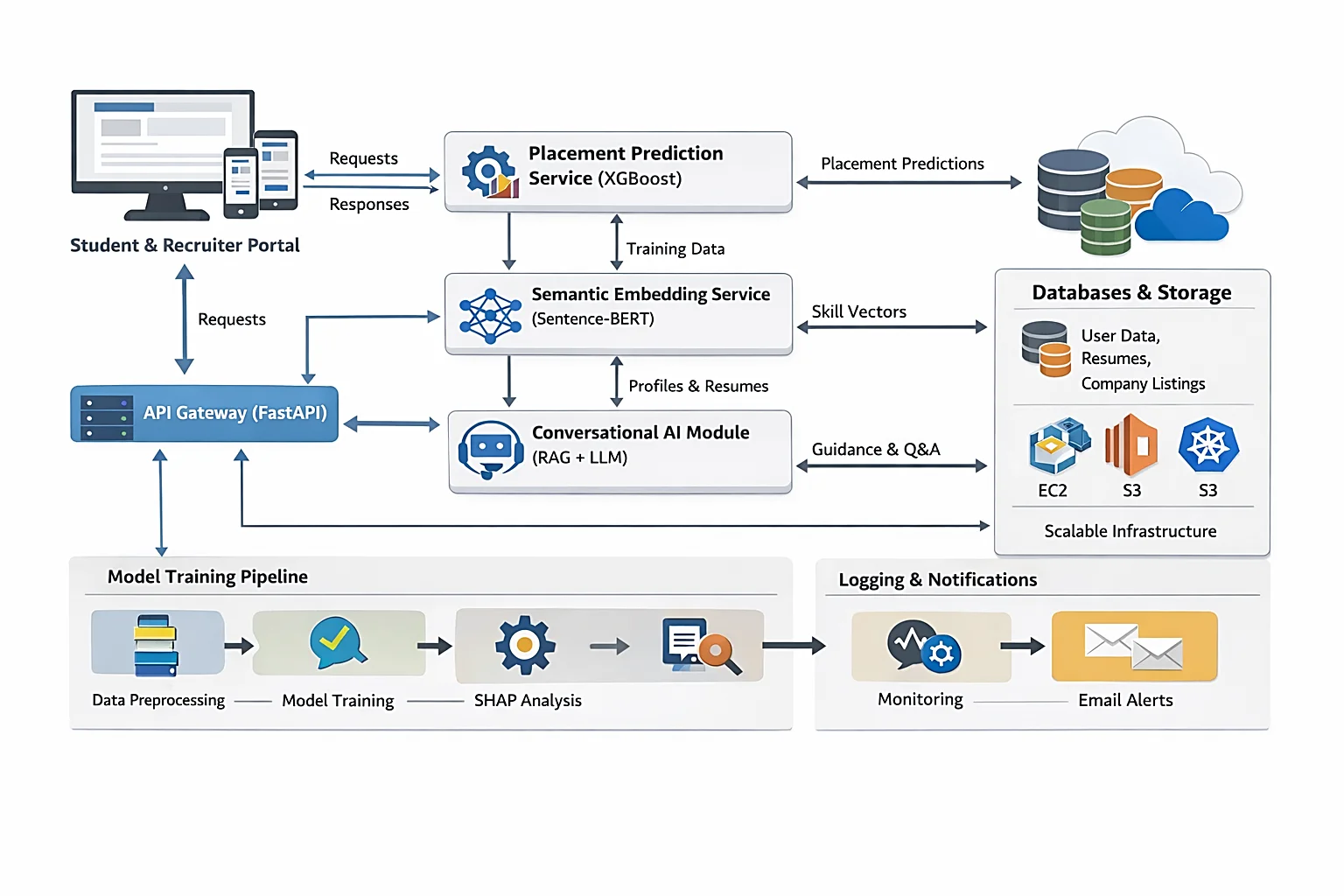
Fig. 2: Architecture diagram
The architecture of the system uses a layered approach to provide scalability and modularity. The client layer contains a web interface for users to interact with the system. All requests to the system are routed through an API Gateway (using FastAPI) that will manage communications between the Frontend and Backend services of the application. The back end of the system has multiple functional services. The prediction service uses the XGBoost model to predict the likelihood of placement for each student. The embedding service uses sentence-BERT as the underlying technology for semantic skill matching. Finally, the chatbot service uses a retrieval-augmented generation (RAG) pipeline to allow users to interact with the service in real time. Each of these services accesses the same central PostgreSQL database that contains student profiles, job information, and placement history. In addition to the previously described services, a separate email notification service is available to support automated communication with users of the system. Finally, the entire system is hosted on a cloud infrastructure platform to provide high availability and scalable services while supporting the efficient handling of multiple simultaneous users.
The activity diagram as illustrated in Fig. 3, shows every step of a student's journey throughout the training and placement system, including going from their first visit through submitting applications and being notified about their results. The journey starts with being authenticated as a user so that existing users can go directly to the dashboard and new students must go through the account creation process prior to proceeding. When students are authenticated, they will be able to update their profiles and the skills that they possess, which will then be used by the system to generate job matches for them on the basis of those profiles. The system then determines if any suitable jobs are available for those students. If so, students will have access to view the available jobs and will have the opportunity to submit an application for those jobs. Once a student submits an application, both the job posting and the application will be reviewed by the placement authority before an applicant is either notified of their eligibility for an interview or advised that they will not be considered for further consideration on the basis of their qualifications. Upon completing an interview or applying for a job, students receive a confirmation email with their application or an order when they apply for work. At this point, the cycle of placement has been closed. This activity flow demonstrates that there is a major emphasis placed on controlling user access on the basis of the role of the user, how to make decisions on the basis of conditions, and how to communicate with users in an automated manner throughout the placement process.
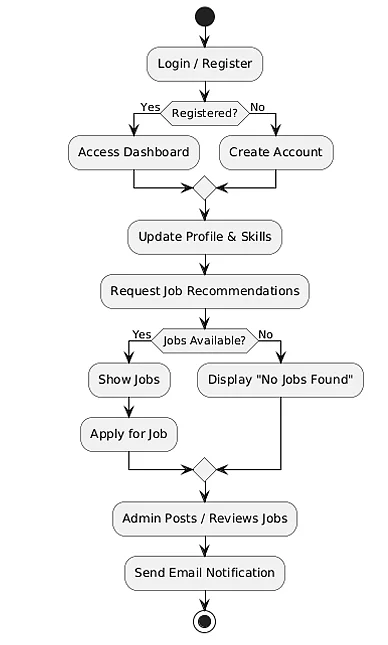
Fig. 3: Activity diagram
6. Results and discussion
A comprehensive set of model-level and system-level metrics was employed to evaluate the performance of the proposed AI-based placement system, with comparisons made against existing baseline methods. Traditional placement systems and earlier machine learning models typically rely on static datasets and limited evaluation metrics, with reported accuracies generally ranging between 75% and 85%. In contrast, the proposed model was evaluated against baseline algorithms such as Logistic Regression and Decision Trees, consistently demonstrating superior performance across all evaluation metrics. Table 2 presents the confusion matrix of the proposed XGBoost model. The proposed XGBoost model achieved an accuracy of 89%, along with strong performance in terms of precision (0.88), recall (0.89), F1-score (0.88), and ROC-AUC (0.88), as summarized in Table 3. These results indicate the model's ability to generate consistent and reliable predictions for student placement outcomes. From a system-level perspective, the proposed architecture achieved an inference latency of less than 150 ms under concurrent user conditions, highlighting its suitability for real-time deployment-an aspect often lacking in previously developed systems. Furthermore, the incorporation of Sentence-BERT embeddings enhanced semantic alignment between student skill sets and job requirements, thereby improving job-matching accuracy. The integration of SHAP-based explainability further strengthened model transparency by providing interpretable insights into feature contributions. Additionally, the combination of an Interactive Experience Management System (IXMS) and a Retrieval-Augmented Generation (RAG)-based chatbot significantly enhanced system interactivity by delivering real-time, context-aware guidance and company-specific insights. Recent advancements in generative AI indicate that RAG-based systems improve response accuracy, interpretability, and contextual relevance through external knowledge retrieval and natural language generation capabilities.[28] Collectively, these results demonstrate that the proposed system not only improves predictive accuracy but also enhances usability, scalability, and practical applicability, thereby establishing it as a comprehensive and intelligent placement solution.
Table 2: Confusion matrix of proposed XGBoost model.
| Predicted: Placed | Predicted: Not Placed | |
|---|---|---|
| Actual: Placed | 520 | 60 |
| Actual: Not Placed | 70 | 550 |
Table 3: Comparative analysis of existing training and placement systems on the basis of prediction accuracy and automation capabilities.
| Model | Accuracy | Precision | Recall | F1 - Score | ROC - AUC |
|---|---|---|---|---|---|
| Logistic Regression (Baseline) | 78% | 0.76 | 0.75 | 0.75 | 0.80 |
| Decision Tree (Baseline) | 82% | 0.80 | 0.79 | 0.79 | 0.83 |
| Proposed XGBoost Model | 89% | 0.88 | 0.89 | 0.88 | 0.88 |
The ROC curve shown in Fig. 4 was employed to evaluate the classification performance of the proposed model by visualizing its behavior across different threshold levels. The curve demonstrates a favorable balance between the true positive rate (sensitivity) and the false positive rate, indicating the model's strong ability to distinguish between placed and non-placed students. The Area Under the Curve (AUC) value of 0.88 reflects a high level of classification performance. Overall, the ROC curve highlights the robust discriminative capability of the proposed integrated system.
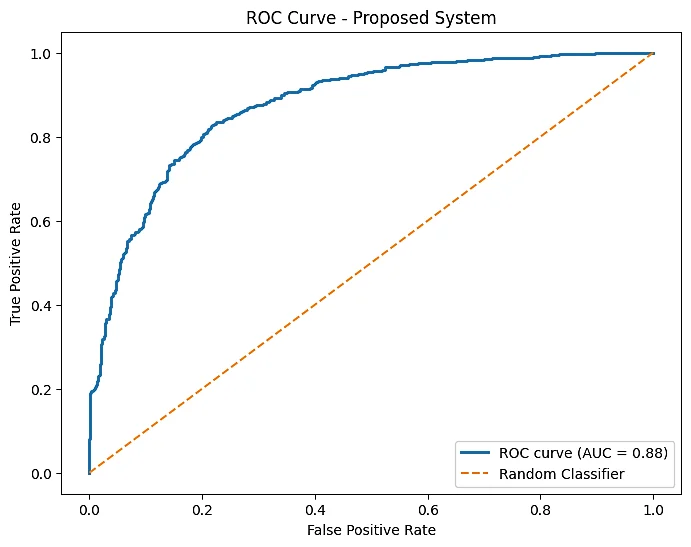
Fig. 4: ROC curve of proposed system.
7. Enhancements in training and placement through ai integration
Several performance measures were analyzed at the individual model and overall system level to conduct an all-encompassing evaluation of the proposed system. A prediction model created using an XGBoost classifier will have been tested for standard classification metrics of prediction accuracy (i.e., classification accuracy, precision, recall, and F1 score), along with the ROC curve or AUC, to ensure that performance is balanced across each of the classifications. The prediction model's predictive accuracy can also be examined via SHAP, which can enhance our understanding of how each variable contributes to prediction or feature performance (e.g., academic performance, skill embedding, and industrial experience [Internship]). The system-level performance metrics also assess the model's ability to generate predictions in a timely and efficient manner. For example, the average time to produce a prediction remains less than 150 ms when it is predicted simultaneously (real-time). Together, these performance metrics provide a comprehensive evaluation of the prediction performance as well as the deployment and usability of the system. Additionally, this multidimensional evaluation approach provides an accurate picture of both prediction performance and deployment/capacity performance, which is something that has not been accomplished with existing research because of the use of singular evaluation approaches. Artificial intelligence (AI) and machine learning (ML) transform training and placement systems through solutions to manage the analytics of employability, recruiting, and student readiness. Typical systems are limited to static data management, whereas AI-enabled systems learn continuously to better inform decision-making through student metrics and by leveraging recruiter feedback and placement results.[3] By automating prediction, communication, and analysis of results, AI enhances the speed and quality of placement operations.[4] Additionally, when converged with intelligent chatbots, predictive algorithms can provide real-time interaction as well as customized recommendations to aid students in measuring their strengths and weaknesses and aligning their profiles to relevant job possibilities.[9] AI-enabled insights help administrators by indicating performance trends, noting skill development gaps, and directing comprehensive training to remedy this deficiency.[10] Ultimately, this creates a more dynamic and data-driven ecosystem that grows and improves with each placement cycle, ultimately leading to further transparency and continuous improvement among all stakeholders. [11]
7.1 Improved placement prediction and decision-making
The use of machine learning algorithms improves the accuracy and effectiveness of placement prediction models. The system is able to process multiple pieces of information on the basis of the skills needed (e.g., academic performance, technical skills, relevant certifications, and interview performance) to determine the most important factors leading to successful placements. AI models learn dynamically with new points of reference and make predictions instead of learning in a static manner with a list of criteria as a general eligibility list, as conventional models do.[29] This adaptive prediction system allows placement officers to make better decisions on training needs and company-specific shortlisting. The model analyses historical data to project which students are best suited to meet specific recruiter needs. It helps recruiters by automating the search for potential candidates and eliminating the time to manually evaluate larger datasets. The AI module of the proposed system uses supervised learning algorithms, including decision trees and random forest, which work well for predictions that require classification. As more placement data are introduced over time, the accuracy of the models improves, making them self-improving decision-support tools. By providing these predictive abilities in the placement experience, organizations can pivot from once reactive placement tracking to a more proactive talent readiness and opportunity matching approach.
7.2 Intelligent chatbot integration and real-time interaction
The implementation of AI chatbots is a significant movement toward increased usage of automation and access in the training and placement process. More traditional means of communication such as emails can similarly create delays, lacunae, or a lack of updates for student recruitment campaigns. Chatbots do streamline and help to bypass these constraints by providing students, placement officers, and recruiters with real-time on-demand access to an exchange of information.[30] Chatbots can also help respond to some of the most common questions in real time, around the eligibility to apply to a company, registration deadlines, or time of interviews, all while decreasing some of the burden placed on staff for documentation and administration. The bot is capable of interpreting user questions and generating context-based responses using NLP. That is, it can be characterized as an agent rather than a helpdesk service. The bot can also push notifications to students, such as announcements about upcoming interviews, outstanding skills sessions, or company updates of relevance to its users. This active engagement keeps students updated and engaged with relevant information throughout the recruitment process. [31] The chatbot system serves a dual function by facilitating user communication while simultaneously functioning as an intelligent system for feedback collection. The system allows users to input data after their interview, which creates the possibility of analyzing student data and generating results that support the system in performing analytical evaluations. The system improves and enhances performance through the collection of ongoing feedback, which signifies training programs and improves the AI prediction model. The chatbot system even provides ongoing user assistance, which leads to increased user satisfaction, and builds a student-centered placement system that operates with full transparency.[32]
7.3 Adaptive learning and continuous system improvement
A considerable benefit of deploying artificial intelligence (AI) in placement systems is its ability to continuously learn and adapt. Traditional systems are generated once implemented and remain the same throughout the duration of the system's use; on the other hand, the AI platform builds and evolves as new data and users engage with the system. Students participate and engage in recruitment cycles, and the system captures outcomes, feedback, and performance data during the cycle that can be used postrecruitment to improve and readjust the students' predictive models and communication strategies.[33] As adaptive learning continues, the accuracy of recommendations and placement prediction that the system has learned from its previous experience will become increasingly precise. For example, once recommendations identify patterns that lead to placement success-such as a specific skill set, project experience or a certification-it will prioritize those same items as it analyzes future options. In contrast, if the model identifies patterns of rejection, it can provide administrators and students with the opportunity to address those weaknesses through specific training sessions. In addition, the addition of chatbots provides opportunities for continual improvement through the collection of qualitative data from users. Information such as student satisfaction, provisioning student reactions, or recruiter feedback could likewise allow for retraining the AI models, improving the user experience and prediction accuracy. Updates of AI models based on feedback make the placement portal a self-improving system that can support institution-wide strategies for navigating an evolving industry environment.[34] The proposed system goes beyond automating the placement decision process by leveraging adaptive learning to develop an intelligent and evolving platform that continuously enhances decision-making, communication, and student success rates.
8. Conclusion
This study presented an AI-driven training and placement platform that integrates machine learning–based prediction, semantic skill analysis, explainable AI, and conversational intelligence within a unified system. The primary objective was to address the limitations of traditional placement systems by introducing a scalable, data-driven framework capable of improving decision-making and student outcomes. The experimental evaluation validated the effectiveness of the proposed approach. The placement prediction model, implemented using XGBoost, achieved an accuracy of 89%, along with strong performance across precision (0.88), recall (0.89), F1-score (0.88), and ROC-AUC (0.88). In addition, system-level evaluation demonstrated real-time responsiveness, with inference latency maintained below 150 ms, confirming the feasibility of deployment in practical institutional environments. The integration of Sentence-BERT embeddings improved semantic alignment between student skill sets and job requirements, thereby enhancing job-matching accuracy. Furthermore, SHAP-based explainability increased transparency by providing interpretable insights into model predictions. The inclusion of a Retrieval-Augmented Generation (RAG)-enabled chatbot enabled real-time, context-aware interaction, supporting students with company-specific preparation and personalized guidance. Overall, the results demonstrate that the proposed system effectively bridges the gap between standalone machine learning models and real-world deployable solutions. By combining predictive analytics with intelligent interaction mechanisms, the system offers a comprehensive, scalable, and transparent framework for next-generation, data-driven placement ecosystems.
Funding Declaration
This research did not receive any specific grant from funding agencies in the public, commercial, or not-for-profit sectors.
Data Availability Statement
The dataset used in this study is publicly available on Kaggle (the “Engineering Student Journey” dataset). It was utilized for research purposes and preprocessed for model training. The processed dataset and related materials are available from the corresponding author upon reasonable request.
Conflict of Interest
There are no conflicts of interest.
Artificial Intelligence (AI) Use Disclosure
The authors confirm that no artificial intelligence (AI)-assisted technologies were used in the writing of the manuscript, and no images were generated or manipulated using AI. AI-based tools were used solely for language editing to improve grammar, clarity, and readability, in accordance with journal policy. The authors take full responsibility for the accuracy, originality, and integrity of the work.
Supporting Information
Not applicable.
References
- [1] D. Magdalenić, L. Luić, Assessing the impact of digital tools on the recruitment process using the design thinking methodology, Administrative Sciences, 2025, 15, 139, doi: 10.3390/admsci15040139.
- [2] Ç. D. Ertuğrul, S. Bitirim, Job recommender systems: a systematic literature review, applications, open issues, and challenges, Journal of Big Data, 2025, 12, 140, doi: 10.1186/s40537-025-01173-y.
- [3] A. Billig, J. Gottschick, K. Sandkuhl, Evolution of web computing systems: experiences from web-portal projects, Proceedings of the 2005 31st EUROMICRO Conference on Software Engineering and Advanced Applications (EUROMICRO-SEAA'05)., 2005, 223-230, doi: 10.1109/EURMIC.2005.27.
- [4] N. Srivastava, M. Tripathi, V. Rai, The development of a job portal to facilitate in campus placement, 5th International Conference on Advances in Computing, Communication Control and Networking (ICAC3N), IEEE, 2023, 1549-1553.
- [5] E. Elbasi, M. Nadeem, Y. I. Alzoubi, A. E. Topcu, G. Varghese, Machine Learning in Education: Innovations, Impacts, and Ethical Considerations, IEEE Access, 2025, 13, 128741-128770, doi: 10.1109/ACCESS.2025.3590134.
- [6] Z. Ersozlu, S. Taheri, I. Koch, A review of machine learning methods used for educational data, Education and Information Technologies, 2024, 29, 22125–22145, doi: 10.1007/s10639-024-12704-0.
- [7] Y. Aljemely, Challenges and best practices in training teachers to utilize artificial intelligence: a systematic review, Frontiers in Education, 2024, 9, 1470853, doi: 10.3389/feduc.2024.1470853.
- [8] R. Qureshi, P. S. Lokhande, A comprehensive review of machine learning techniques used for designing an academic result predictor and identifying the multi-dimensional factors affecting student's academic results, 2024 2nd DMIHER International Conference on Artificial Intelligence in Healthcare, Education and Industry (IDICAIEI), Wardha, India, 2024, 1-6, doi: 10.1109/IDICAIEI61867.2024.10842901.
- [9] R. Srimathi, J. Naskath, B. A. Mathavan, T. Archana Pown, M. S. Rabiya, Institution management system: student module, 2022 Fourth International Conference on Cognitive Computing and Information Processing (CCIP), Bengaluru, India, 2022, 1-8, doi: 10.1109/CCIP57447.2022.10058674.
- [10] S. S. Sakthy, G. A. Macriga, J. A. Jasmine, V. V. Babu, N. M. Sayhanuddin, Integrated web application for skill development and job application, 2021 4th International Conference on Computing and Communications Technologies (ICCCT), Chennai, India, 2021, 106-110, doi: 10.1109/ICCCT53315.2021.9711801.
- [11] M. Babu, K. Sandhiya, V. Preetha, S. Sankara Eshwari, M. R. Chitra, Design of alumni portal with data security, 2021 Second International Conference on Electronics and Sustainable Communication Systems (ICESC), Coimbatore, India, 2021, 1-7, doi: 10.1109/ICESC51422.2021.9532986.
- [12] R. K. Kousik, G. Nagappan, Computer human interface for placement management system, 2024 IEEE International Conference on Computing, Power and Communication Technologies (IC2PCT), Greater Noida, India, 2024, 1245-1248, doi: 10.1109/IC2PCT60090.2024.10486671.
- [13] V. Pavani, N. M. Pujitha, P. V. Vaishnavi, K. Neha, D. S. Sahithi, Feature extraction based online job portal, 2022 International Conference on Electronics and Renewable Systems (ICEARS), Tuticorin, India, 2022, 1676-1683, doi: 10.1109/ICEARS53579.2022.9752295.
- [14] M. R. N. King, S. J. Rothberg, R. J. Dawson, F. Batmaz, Bridging the edtech evidence gap: A realist evaluation framework refined for complex technology initiatives, Journal of Systems and Information Technology, 2026, 18, 18–40, doi: 10.1108/JSIT-06-2015-0059.
- [15] S. Shivani, R. Srivastava, N. Tiwari, Developing an e-learning and job portal for IT aspirants, 2022 International Conference on Applied Artificial Intelligence and Computing (ICAAIC), Salem, India, 2022, 160-165, doi: 10.1109/ICAAIC53929.2022.9792727.
- [16] V. S. Tadla, P. M. Singh, K. M. Thakkar, R. Adatkar, Campus placement using machine learning: an extensive review and comparative study of machine learning methods, 2023 6th International Conference on Advances in Science and Technology (ICAST), Mumbai, India, 2023, 427-430, doi: 10.1109/ICAST59062.2023.10455050.
- [17] S. D. Shriramjwar, O. V. Chandure, A study paper on college collaboration portal with training and placement, International Journal of Research In Science & Engineering, 2018, 3, 78–81.
- [18] G. Jewani, S. Sahare, T. Kamble, R. Kathalkar, A. Unhale, Online training and placement system, 2023 IEEE International Students' Conference on Electrical, Electronics and Computer Science (SCEECS), Bhopal, India, 2023, 1-5, doi: 10.1109/SCEECS57921.2023.10063051.
- [19] A. S. Sharma, S. Prince, S. Kapoor, K. Kumar, Placement prediction system using logistic regression, 2014 IEEE International Conference on MOOC, Innovation and Technology in Education (MITE), Patiala, India, 2014, 337-341, doi: 10.1109/MITE.2014.7020299.
- [20] S. Vora, A. Arya, C. Kumbhar, H. Dalvi, An AI-based adaptive assessment system for effective campus placement process management, AIP Conference Proceedings, 2023, 2916, 020014, doi: 10.1063/5.0177537.
- [21] B. Bhuvaneswaran, R. Reshma, V. Soniya, JobQuench: An intelligent and automated placement management system for enhanced campus recruitment, 2025 Third International Conference on Augmented Intelligence and Sustainable Systems (ICAISS), Trichy, India, 2025, 1427-1435, doi: 10.1109/ICAISS61471.2025.11042066.
- [22] A. Turkmenbayev, E. Abdykerimova, S. Nurgozhayev, G. Karabassova, D. Baigozhanova, The application of machine learning in predicting student performance in university engineering programs: a rapid review, Frontiers in Education, 2025, 10, 1562586, doi: 10.3389/feduc.2025.1562586.
- [23] N. Kathirisetty, R. Jadeja, H. K. Thakkar, D. Garg, C.-C. Chang, R. Mahadeva, Student placement probabilistic assessment using emotional quotient with machine learning: a conceptual case study, IEEE Access, 2023, 11, 125716-125737, doi: 10.1109/ACCESS.2023.3330320.
- [24] N. Mezhoudi, R. Alghamdi, R. Aljunaid, G. Krichna, D. Düştegör, Employability prediction: a survey of current approaches, research challenges and applications, Journal of Ambient Intelligence and Humanized Computing, 2023, 14, 1489–1505, doi: 10.1007/s12652-021-03276-9.
- [25] A. Pathak, M. Matcha, M. Gopisetti, S. Joshi, A machine learning framework for predicting student placement outcomes, 2025, 30, 1715-1720, doi: 10.18280/isi.300704.
- [26] J. T. Hancock, T. M. Khoshgoftaar, Q. Liang, A problem-agnostic approach to feature selection and analysis using SHAP, Journal of Big Data, 2025, 12, doi: 10.1186/s40537-024-01041-1.
- [27] J. He, Y. Luo, T. Wang, iDigiChat: intelligent digital marketing service chatbot for providing efficient customer services using artificial intelligence, Scientific Reports, 2025, 15, 33074, doi: 10.1038/s41598-025-14722-5.
- [28] M. L. Bernardi, M. Cimitile, G. Panella, R. Pecori, G. Simoncelli, Automatic generation of job safety reports with explainable RAG-based LLMs, Information Systems Frontiers, 2025, doi: 10.1007/s10796-025-10634-x.
- [29] I. H. Sarker, AI-based modeling: techniques, applications and research issues towards automation, intelligent and smart systems, SN Computer Science, 2022, 3, 158, doi: 10.1007/s42979-022-01043-x.
- [30] H. R. Swapna, D. Arpana, Chatbots as a Game Changer in E-recruitment: An Analysis of Adaptation of Chatbots, In: Kumar, R., Mishra, B.K., Pattnaik, P.K. (eds) Next Generation of Internet of Things, Lecture Notes in Networks and Systems, Springer, Singapore, 2021, 201, doi: 10.1007/978-981-16-0666-3_7.
- [31] J. He, Y. Luo, T. Wang, iDigiChat: intelligent digital marketing service chatbot for providing efficient customer services using artificial intelligence, Scientific Reports, 2025, 15, 33074, doi: 10.1038/s41598-025-14722-5.
- [32] I. Engeness, M. Nohr, T. Fossland, Investigating AI Chatbots' role in online learning and digital agency development, Education Science, 2025, 15, 674, doi: 10.3390/educsci15060674.
- [33] K. Karwa, Leveraging AI and digital technologies to transform on-campus recruitment for design students: enhancing employer engagement and hiring outcomes, 2025, 11, doi: 10.22399/ijcesen.3779.
- [34] A. Fageeh, The rise of chatbots in higher education: Exploring user profiles, motivations, and integration strategies, Social Sciences & Humanities Open, 2025, 12, 101996, doi: 10.1016/j.ssaho.2025.101996.
Publisher Note: The views, statements, and data in all publications solely belong to the authors and contributors. GR Scholastic is not responsible for any injury resulting from the ideas, methods, or products mentioned. GR Scholastic remains neutral regarding jurisdictional claims in published maps and institutional affiliations.
Open Access
This article is licensed under a Creative Commons Attribution-NonCommercial 4.0 International License, which permits the non-commercial use, sharing, adaptation, distribution and reproduction in any medium or format, as long as appropriate credit to the original author(s) and the source is given by providing a link to the Creative Commons License and changes need to be indicated if there are any. The images or other third-party material in this article are included in the article's Creative Commons License, unless indicated otherwise in a credit line to the material. If material is not included in the article's Creative Commons License and your intended use is not permitted by statutory regulation or exceeds the permitted use, you will need to obtain permission directly from the copyright holder. To view a copy of this License, visit: https://creativecommons.org/licenses/by-nc/4.0/
© The Author(s) 2026